Showing posts with label Mary. Show all posts

Legion of Mary, in St. Peter's Square!

In your second semester at the NAC you get assigned an apostolate, which usually involves some kind of work in the fields of evangelization or charitable work.  Options are as varied as working with the Missionaries of Charity to feed the poor, to teaching students catechism, to giving tours of St. Peters, to - and this is the one I am blessed to be a part of - evangelizing pilgrims in St. Peter's square as part of the Legion of Mary.  Lets just say, it's an amazing apostolate!

Like any other Legion group (it is a worldwide organization, with "Legions" of Mary at Parishes all over the place), the 10 or so of us meet once a week and pray the rosary, read out of the hand-book (both devotional, speaking about the beauty of emulating and following Our Lady, and practical, as in, how to do that out in the world when trying to evangelize), and go through the reports of what all the members did over the past week.  In our case, the work we do doing during the week is always evangelizing down in St. Peter's Square.  We go out in pairs, for about 2 hours, and just make ourselves available to whoever wants to talk with us during the time.  So, I've been out a handful of times now (I started at the beginning of this semester), with a couple of different guys, and it has had a profound effect on my approach to evangelization, my confidence in approaching and conversing with strangers, and my excitement for the priesthood.  

Regarding evangelization, two factors have made this apostolate a fantastic chance to learn how to take the Gospel out to the world.  Firstly, the other guys that I've been going down there with are great examples - they're zealous, loving, excited, patient, knowledgable, and approachable - and they've taught me a lot about how to jump into a conversation with a random pilgrim in the Square.  I found myself prone to sort of dismiss those who just wanted directions to the Vatican Museum or the times for Masses in St. Peter's; it was easy just to give them the info and send them on their way.  But, as the other guys showed me, evangelization often begins with the most humble of openings - just ask them how they liked St. Peters, or how long they've been in Rome, or where they are from, and boom, things happen.  Like the lady we encountered asking where to buy rosaries - simple, I thought, head down the Borgo Pio and you're set - but instead we started to talk with her, and she started talking about her kids, the trip she was currently taking with her husband, and asking about our vocations and what we were doing in Rome.  We ended up inviting her to the NAC for Evening Prayer, went out for dinner afterwards, and it turned into a profound conversion experience for her and her husband who hadn't been to church in years!  Factor number two: a lot more people have questions about the Church and the faith, than I would have thought.  I guess I figured that most people wandering in and around St. Peters would be Catholics, or at least Christians, coming to the center of Christ's church here on earth.  But, that is not the case at all.  Sure, there are many, many pilgrims who don't have questions about the faith, but an awful lot do!  Is Pope Francis changing the Church's teaching on marriage, abortion, etc? (answer: nope - Jesus taught otherwise.)  Will we have female priests? (answer: nope - Jesus chose otherwise.)  Why are the churches so lavish, yet there are poor people all around? (answer: love of the poor has to be integrated with love of God, beautiful churches aren't antithetical to caring for the poor), Why is Peter this important? (answer: Christ chose him to lead His church, as He chooses every Pope to continue being his vicar until His return).  

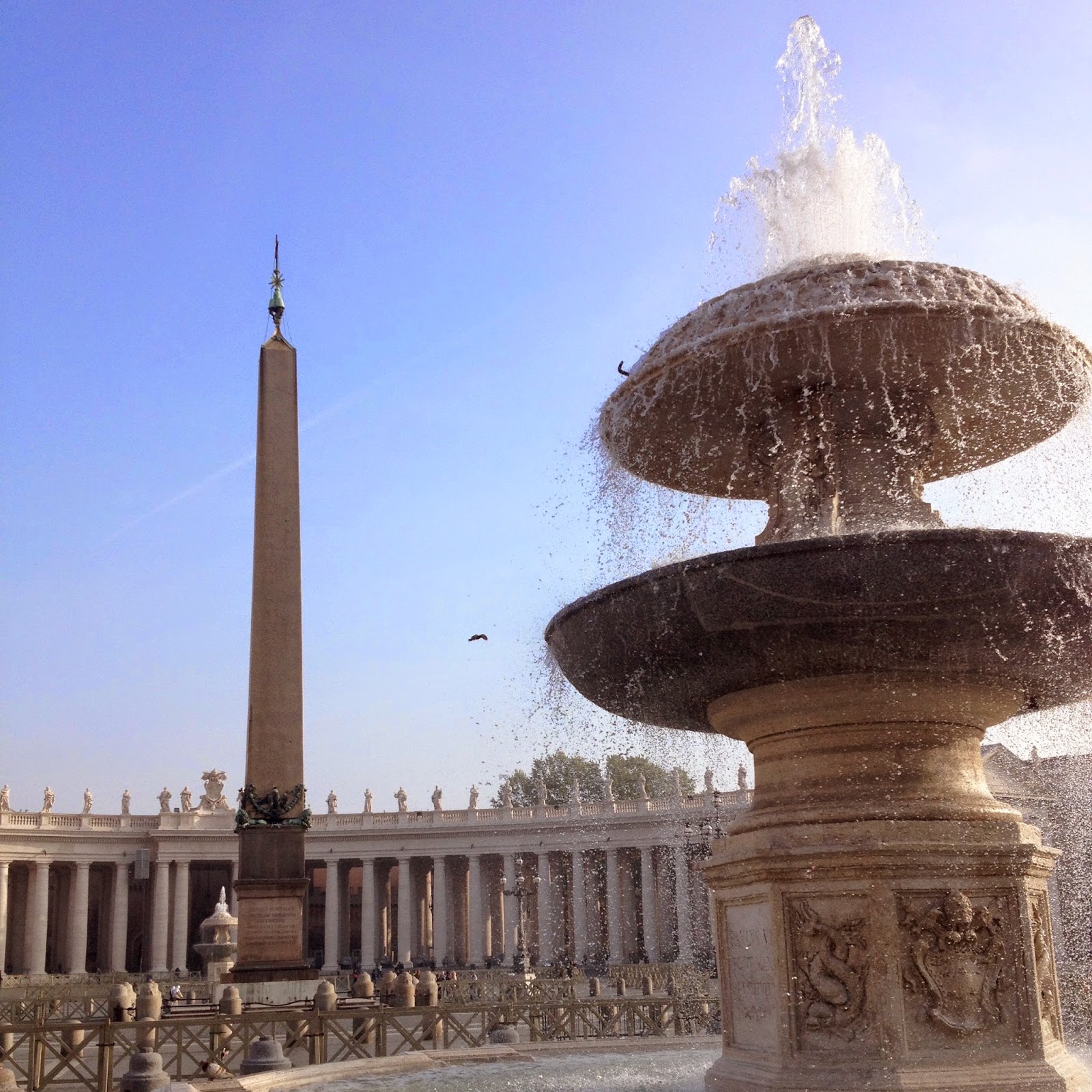
The Fountains are Flowing Again!
(they are especially beautiful at night, lit up from below)
Obviously, conversations have gotten a lot deeper than that, and I don't want to leave you with the wrong emphasis by my summary of conversations that we've had.  I've learned that above all it's important to not go into a situation with the idea to argue the person out from their error to the truth.  Yes, apologetics plays a role in the conversations - that's part of proclaiming the truth - but, possibly just as important, is exuding the joy and excitement that comes from following Christ.  People don't like an argument, even if it's convincing, they do like happiness.  Christ offers both: truth and joy, and they do go together, but a glum, argumentative, seminarian doesn't change anybody's life, whereas a person who is excited about the truth does!  (Obviously, with God's help.  That example I gave above truly made me realize this.  I said very little during the multi-hour conversation, yet, somehow, God was able to work through our presence to bring Himself to this couple.)  Being "confident" doesn't mean being macho, and off-putting, it means being willing to share the faith, the relationship with Christ, that I have been blessed to have.  It means showing just how amazing life is when you give it over to Him.  Yep, there are crosses - classes are hard, I don't have enough time to do everything I want (hmmm. maybe it's not all about me...), I'm not perfect, I'm far from home - the cross is part of following Our Lord, but there are so many more blessings!  The chance to be 5 minutes from the Vatican, to play soccer in sight of the dome of St. Peters, to travel around Europe, to delve into the mysteries of the faith, to walk past a dozen beautiful, ancient, saint-filled, churches on the way to class every morning, to start every day with Mass, and spend a couple hours talking with God every day - it's awesome!  Does following Christ automatically mean fun travels and great classes? No. But it does mean fulfillment, the peace of knowing that every moment - good, bad, easy, hard, boring, or busy - is a gift from Him, a gentle reminder to turn to Him and be thankful for His love.  It is challenging, but it is rewarding, and the world doesn't know that those things can go together (they can!)  Evangelization isn't faux-confident, overbearing, pounding-in-the-truths-of-the-faith, arguments; no, it's about living ones life according to Christ and thereby showing just how amazing that is.  This is what the early Christians did (above all in their willingness to die for their faith, confident in Christ and peaceful in knowing that eternal life awaited those who turned their lives over to Him), and they transformed the world!

Last point: Being down there, in the collar, bringing the faith to those traveling through Rome, has made me ever more excited to one day, God willing, be a priest.  Gosh, ordination could be only 3 years away at this point - that's crazy (as in, time is flying by), but it's also exciting!  I can't wait to get back to my diocese and minister to the people there, bringing them the faith that I've experienced here in Rome, the sacraments, an amazing opportunity to encounter our all-loving God, and the inspiration of so many faithful that I've encountered here (that's something that I didn't even talk about in this post, as well as devotion to Mary...  Ah well, it can't be a dissertation.)

So yeah, it's an amazing apostolate and I am so glad that it was the one chosen for me!  So much to learn, so much to see, so much to do - all from, and for, Christ!

Advent - Letting God Come to Us

Welcome to Advent (a couple of weeks late)!  Here at the NAC we just had our annual Christmas party (basically, a fun meal - accompanied by the 3rd year guys providing music and cookies followed by a free-night in the lounge - think ice-cream, beer, and some of the guys composing a band, all surrounded by the completion of all the Christmas decorations around the NAC - think lights, and snowmen, and banners, and guys-dressed-up-as-elves all over the place).  However, despite all these festivities, and entering the last week of classes before break, and seeing lights and trees going up all over the eternal city, we are still in Advent, and that is a good thing! 

Here's why:  Advent is meant to be a time when we get prepared for the coming of Christ.  Obvious right?  Well, St. Bernard reminds us that this isn't as obvious, or as easy, as we'd think. 
"there are three comings of the Lord.  The third lies between the other two.  It is invisible, while the other two are visible.  In the first coming he was seen on earth, dwelling among men; he himself testifies that they saw him and hated him.  In the final coming all flesh will see the salvation of our God, and they will look on him whom they pierced.  The intermediate coming is a hidden one; in it only the elect see the Lord within their own selves, and they are saved.  In his first coming our Lord came in our flesh and in our weakness; in this middle coming he comes in spirit and in power; in the final coming he will be seen in glory and majesty." 
The Church divides the liturgy of Advent into two halves: the first 2 or so weeks of Advent emphasizing, in the readings at Mass and Liturgy of the Hours, the second coming of Christ (at the end of time, to judge the world) and the last 2 weeks of Advent emphasize the first coming of Christ (in the Incarnation, to save the world).  However, while these are incredibly important things to meditate on - God becoming man, yep, pretty world-changing; the end of the universe, again, pretty big deal - often in celebrating Christ's coming 2000 years ago, or getting excited about His coming in the future, we forget that He wants to enter our hearts and lives every day, right now.  Bernard continues:
"Listen to what our Lord himself says: If anyone loves me, he will keep my word, and my Father will love him, and we will come to him. There is another passage of Scripture which reads: He who fears God will do good, but something further has been said about the one who loves, that is, that he will keep God's word.  Where is God's word to be kept?  Obviously in the heart, as the prophet says: I have hidden your words in my heart, so that I may not sin against you.  Keep God's word in this way.  Let it enter into your very being, let it take possession of your desires and your whole way of life ... If you keep the word of God in this way, it will also keep you.  The Son with the Father will come to you." 
So, our goal this Advent has to be to truly prepare ourselves for Christ's coming - not only by considering the Incarnation, recognizing the incredible love that Jesus humbly shows us at Bethlehem, and not only in making sure we'll be ready when Christ comes in glory - but even more immediately, in being ready for Him to enter our hearts now, at this moment, in the Eucharist, in the Scriptures, in those we meet. 
I was listening to a homily by Fr. Michael Schmitz and he recounted how he had been struck by a quote which read something like "do I desire to love God as much as He can be loved?"  That's a question that we all need to ask ourselves (and I've been asking myself these last few weeks).  Do I desire, do I strive, do I pray, to have the grace, strength, conversion-of-heart, fervor, and everything else, to love God, as much as He can be loved.  The fact is that we are created to love God, and only in loving Him will we find true fulfillment.  No amount of Christmas cookies, the latest technological gizmo, going out to eat, watching movies, plush cars, honors, or even friends will fill our hearts because they have been created for something more, for something infinite, for someone (God) to fill.
Our Lady of Humility, Pray for Us!
However, here we can fall into another trap: trying to fill ourselves with God.  It's tempting to think that if we pray enough, or read enough theology, or kneel stoically enough, or fast arduously enough, that we will turn ourselves into saints and - boom - live happily ever after (with God dwelling within us).  The problem: praying, studying, kneeling, and fasting aren't any good if we're doing them out of our own pride (thinking ourselves better than others, or thinking that we're now deserving of God).  Sanctity, holiness, grace, divine-love, Christ dwelling within us - it's all a complete gift of God.  We can't deserve it; we can't earn it; we can't "steal" it.  We can only accept it.
I am a "doer", I'm that guy that thinks that if I fit in another holy hour, or pray that extra devotion, or read some extra book, or make another sacrifice, then I'm making myself a saint, but while all those things are great, they aren't the most important.  Martha was a doer, she was, I'm sure, running around making a delicious meal for Jesus, but Mary, who isn't doing anything, just sitting at Our Lord's feet, is the one who has chosen the "better part".  Samuel, in the Old Testament, gives us an example as well, responding to God, "speak, Lord, your servant is listening".  We, this Advent, need to have this mentality.  Before we start doing something, we need to  allow Christ to do the doing within us.  We can't fill ourselves with His love, only He can.  Certainly, we must be attentive, we must be listening, but - above all else - we must simply be open to God, and not filled with our own desires, plans, goals, or ideas.  St. Bernard has this in mind when he exhorts us to "let [God] take possession of your desires and your whole way of life".  Our job isn't  so much to go bulldozing through our life, making room for Christ, how we think we should, but instead we should simply surrender to His will, in each and every moment, and allow Him to make room within us for His love. 
Some days things don't happen the way we want them too - so many times I get to the end of the day and I think "gosh, I didn't get as much done as I wanted to today".  But this is my own idea of a productive day, God simply wants me to get to the end of the day and ask if I loved God as much as I could that day.  He doesn't ask for efficiency, but charity, not production, but love.  Blessed Mother Theresa was quoted saying "do little things with great love".  It's a quote we've all heard before, but do we follow it?  Are we willing to be so humble as to accept whatever God - in His providence - has planned for us today, and simply trust that He will give us the grace necessary to do it in the loving way that He wants.  Are we willing to surrender to such an extent that we allow Christ to come to us, and not try to force our way to Him? 

In His coming at Bethlehem Christ emphasizes humility.  In His middle coming into our heart - whether through sacrament, scripture, or neighbor - He also emphasizes humility.  Christ humbles Himself completely in order to come with us, are we willing to stoop low enough to enter that stable with Him - to leave behind our own ideas, plans, or whatever, and simply kneel there in His presence?  Are we willing to be like Joseph, silent before the Christ child, simply gazing upon God's incarnate love?  Are we willing to be like Mary, staying the night in a stable because nobody else cared?  Are we willing to round up our sheep, tossing out our own plans, like the shepherds, and tromp into Bethlehem to bow before our infant king?  Are we willing to pack up our treasures and sit on a camel for a month, to just catch a glimpse of Jesus?  All the figures we see didn't really do something to earn God's coming to them, they were just ready to obey when God announced it to them.  We too, during this advent, aren't so much called to do something, as we are called to willing do whatever God places before us. 
For me, that means studying Hebrew (one of my classes this semester) - not exactly my favorite past-time - is more important than doing something different where I think I will encounter God.  Praying the Office - even when I think it gets repetitive, or boring, or tiring - is a better prayer than whatever devotion resonates with me this week.  You get the picture, following God's plan is more important that following our own plan.  Why?  Because God can only enter the humble heart.  The heart filled with its own plans, ideas, or pseudo-holiness, doesn't have any room for God.  Advent isn't for replacing our old attachments with new, better, ones, it's for emptying our hearts of our own attachments completely and letting God fill us.  Back to the analogy of listening: we aren't supposed to start pumping new, better, music through our ears, but to stop filling our ears with any noise and just allow God to speak. 
Is this hard?  You better believe it!  Stepping back, accepting everything as an opportunity to follow God's will, listening, surrendering - all these things mean coming out of ourselves and dying to self.  You have no idea (ok, maybe some of you do) how hard it is for me to kneel there during a holy hour and not pick up a book to read.  I want to do something, I feel like I am so distracted when I'm just there, doing nothing, in the presence of God.  But God so often comes quietly, humbly, simply.  2000 years ago, God came - not as a mighty, world-conquering, evil-pulverizing, divine king - but as a child, a weak, helpless, approachable, little baby.  And, today, He enters our hearts in the same way - in silence, in stillness, tenderly knocking and asking if He can enter. 
Do you desire to love God as much as He can possibly be loved?  That's the question this post began with, and hopefully that is the question that it ends with.  Christ comes to bring us love, to unite us with God, to restore us to the original union He had planned for us since the beginning.  Advent is a time of preparation, not in the sense of packing up our stuff and asking God where He wants to send us, but in leaving our stuff behind and watching Our Lord, to follow the path He takes before us - the path of humility, love, and obedience.  May we pray, with Our Lady, that God's will be done, in us, according to His word - not expecting, or predicting, or presuming, what God wants us to do, but allowing His will to unfold before us and accepting whatever it might be with His gratitude, enthusiasm, joy, and love.  Not filling ourselves with our own love - whatever that might mean - but simply remaining open to God filling us with His love, and stretching us to hold more of His love, throughout every day.  Not doing something to try and bring Christ to us, but just being ready to receive Him when He comes.

A Day in the Life at the NAC

About a year ago I wrote an entire week of posts, basically just describing what the day-to-day life of seminary involved at Brute.  Well, now I'm in Rome, at the NAC, and I figured that you guys might be interested in the day-to-day happenings here.  I've only been able to write a few posts so far unfortunately, and I found that I really wasn't speaking to much on what the usual life here is like - I either talked just about one little moment or like an entire month, neither of which really tells you what the typical day is all about.  So, without further ado, here's today:

So, this morning the alarm went off at 5 AM.  Unfortunately, I stayed up till midnight last night working on a paper that's due in my theology seminar tomorrow and skyping the family (a seven hour time differential wreaks havoc with communication), so I woke up pretty tired.  Nevertheless, after quickly shutting off the alarm, I creaked down from my bed (I have a loft, which is great, but it does shake a bit when I move around on it), and proceeded to try and wake myself up by doing this "seven minute workout".  It's an app that I found for my phone that times out thirty second intervals during which you do push-ups, jumping-jacks, crunches, lunges, or whatever.  So, seven minutes later I was breathing a bit harder, just about to start sweating, and very much awake.  I turned on a podcast - this one happened to be Fr. Fessio on Catholic Answers Live - and proceeded to get dressed (in clerics! - which is still pretty cool even after wearing them every day for a month or two), brush my teeth, shave, and do those other things that are necessary each morning.  10 minutes later the podcast was paused, I grabbed my breviary, a prayerbook, a notebook, and Scott Hahn's The Lamb's Supper, and rattled down the 6 flights of stairs to the chapel.  It was now about 5:30 and I spent the next 45 minutes doing the Office of Readings, meditating a bit on the readings for the day, reading a chapter on the Mass out of Scott Hahn's book, and just spending some quiet minutes preparing myself for Mass and offering up the entire day to God.  I was certainly tired, but not to such an extent that prayer was impossible, and there was something beautiful about just telling God that - despite everything - I was going to try and give Him my best today.  Nothing spectacular on my end, but a good start to the week nonetheless.

Morning Prayer began (in common) at 6:15, followed by Mass, and - I have to say - I wasn't struggling quite as much as I thought I would based on the amount of sleep I got last night.  I think the time change (which happened last weekend here in Rome) helped because it is now light when we come out of the chapel after Mass (which was a happy surprise this morning, but probably something that unconsciously was helping me stay awake).  One of the deacons (I hate to say it, but I didn't remember his name and I forgot to look it up) gave a very good homily on how Jesus intended to heal the woman on the Sabbath because He is the Logos, the Word made flesh, through Whom the world was first created, and His salvific mission is to bring God's creation back into right relationship with God.  Brokenness, sinfulness, hatefulness, sickness - and every other kind of evil - weren't there when God created the world - He created it good.  But through man's choosing themselves over God - in sin - evil enters the world, and the world becomes twisted, broken away from God.  Jesus enters to bring the world back to God (and radically bring God into the world).  He heals, not to disregard the Sabbath, but to bring mankind to true rest, apart from sin, in union with God.  And, of course, He invites us to that same rest, that same union, every day in Holy Communion!  

After a couple minutes of prayer following Mass I walked down the hall to the refectory for breakfast, which, this morning anyway, involved leftover cornetti (sweet croissants) from yesterday, hard boiled eggs, and some yogurt/cereal/plum concoction.  15 minutes later - after chatting with some guys while eating - I charged up the 6 flights of stairs to my room, spent about 10 minutes getting ready for class, and then grabbed a jacket (it was in the 50s this morning), headed back down the stairs, and out onto the streets of Rome.  Originally, I began my walk listening to another podcast (gotta spend every moment wisely!) and studying the Hebrew alphabet (not terribly easy to do simultaneously), but after about 10 minutes I ran into some other guys on the way to class and so we spent the rest of the 30 minute walk talking about Rome, classes, plans for the rest of the day, and other such things.  It's funny how quickly I got used to walking over to class - it's crazy to think that I get to walk past the Piazza Navona, Santa Maria sopra Minerva, and the Pantheon every day on my way to class!  Fun times!

I arrived at the Greg. (Pontifical Gregorian University - if you want the full name) at about 8:20, with just enough time to head up the 2 flights of stairs, get settled into my desk, and log into the wifi before class began.  Classes are all in Italian - which, today as always, was a struggle.  We had two hours of Pentateuch and then 2 hours of Church History, both divided into two 45 minutes periods with a 15 minute break in between.  I am always very glad when the raucous bell goes off (it really does make a racket) and we get the break because it offers me a chance to clear my mind, stretch a bit, pray a bit (there is a very nice chapel up on the 3rd floor), or otherwise relax a bit - a very necessary thing to do because after 45 minutes of struggling mightily to translate what the professor is saying and type it out, my brain is usually pretty much fried and very ready to get distracted.  Classes have been getting better over the last 3 weeks, I guess I'm picking up new words and getting faster at translating, but I am very glad that guys better at Italian than myself are taking notes (that we then share) because otherwise, I'd be left with only about half of what we talk about in class.  Speaking of which, today we finished talking about the flood and began studying the tower of babel - and how God constantly tries to return man to His loving plan for creation, and away from mankind's tendencies to try to make himself God, and take the easy road to happiness, power, glory, or whatever.  In Church History we talked about the persecution of the early church - the writings of the Church Fathers at that time (St. Justin, St. Ignatius, St. John Chrysostom, etc.), other sources we have of that period (The Acts of the Martyrs, The Letter to Diagnetus, etc.), and the reasons behind the persecution and the phases it went through under different emperors.  That class, in particular, I'm going to have to rely on the notes because while there were PowerPoint slides (which are much easier to translate than simply an oral lecture), they each had about a thousand words on them - so it seemed - so I usually got about half-way through the slide before he flipped onto the next one...  Anyway, piano, piano (slowly, slowly).  In between the first and second period I took like a micro-nap (first time I've ever done that), which actually helped a ton with staying alert for the rest of the time, for the second break I spent some time in the chapel (again, dedicating the work of the day to Our Lord), and I think I just talked with some of the other students for the last break (there are probably about 80-100 students in the class, 20-something of which are from the NAC, and all the others are from other universities or orders around Rome, most of which don't have English as their first language, or Italian, so that can be a struggle at times as well - ah well, we keep trying!)

The walk back was beautiful!  It was just warm enough to not need the jacket, and it was just cool enough to not start sweating on the hike up the hill to the NAC (we're located on the Janiculum hill, one of the 7 hills of Rome).  As always, the streets are busy in places (mainly with people, we actually only have to worry about cars at a couple of intersections), and there are many people stuck in poverty who we always try to give at least a "bongiorno" and a smile.  I'm still getting used to both groups, and trying to constantly remember to be not only polite, but kind and loving - even if only for the moment.  It's one of those things, wearing the collar constantly reminds me of my call - especially as a seminarian - to live, and love, like Christ, which is a constant challenge, especially when you'd really rather just hurry back and get some lunch than stop and give somebody directions, or struggle to communicate your compassion to that homeless lady who always calls out to you as you walk past.  It's a real challenge, one that I didn't expect, and one that I need to constantly take to prayer!

Today, for the first time, I served at pranzo.  That basically means that instead of saying the Rosary like I usually do upon getting back (there's about 20 minutes between us getting back and pranzo), I instead headed into the refectory and started to set out jugs of water and bowls of salad on all the tables (36 tables, 2 jugs each, and the water-machines are pretty slow - it takes a while even with a couple guys working on it).  Then, after about 10 minutes we started carrying back salad plates and carrying out trays of pasta (today was noodles with a creamy red sauce and little flakes of ham - really good but I have no idea what it was called).  20 minutes later, the process repeated, this time carrying back the plate used for pasta and bringing out the secundo (today it was roast beef of some sort with tomato sauce along with peas).  And, a couple minutes after that it was time to carry out bowls of fruit (the dessert for today) and continue to clear plates and stuff.  I would have thought there would be down time, but there wasn't.  I was constantly on the move, going to fetch more food, or cheese, or water, or trying not to drop a stack of plates and silverware (always a balancing act).   Either way, at 2, everybody finishes up, the waiters sit down at their own table, and then we get to eat our own pranzo (same as everybody else's, but we just wolfed it down, and headed off to get things done that afternoon).  It was a fun first time - not hard, not easy, not bad - yeah, actually kind of fun!

I spent the next two hours in the library, working on the process of note-redacting.  Basically, because I'm not one of the chosen note-takers, I have the other job of taking the notes from three different guys for one of our classes (Introduction to Scripture) and combing them all.  The goal is to then have a pretty complete set of notes for the class which everybody can then use to fill in the gaps in their own knowledge.  I thought the process would be easy - boy, was I wrong.  It was such a challenge to look at the 3 or 4 different sets of notes, figure out when they are talking about the same thing, and then combine them in such a way that you lose nothing of any of their meanings but don't repeat anything at the same time.  It was way more of a challenge than I anticipated, and it took all two hours I had open in the afternoon (which I was hoping it wouldn't).  Anyway, such is the way it worked out - I'll have to find more time in the future to do it - but for today, I didn't have any more time!  After struggling to get the computer to save (the network wasn't working quite right) I raced out of the library, down to the St. John Paul II class-room (we don't usually have classes here at the NAC, but they do have some rooms for the occasional lecture or something I suppose), where I attended a meeting of the Legion of Mary.  

I was in the active Legion back at home, before seminary, so the meeting itself wasn't new, but I wanted to check it out as a possible apostolate for next semester because their work sounds really, really cool.  Basically, next semester I'll have an apostolate - which could be helping at a nursing home, working at a soup kitchen, visiting a prison, leading tours of St. Peter's, or - another option - doing evangelization in St. Peter's square for the Legion of Mary.  It sounds really fun actually - standing out there, meeting and greeting tourists who come there and answering any questions they have about the basilica, the Church, Christ, His saints, or any of the other innumerable questions that come up when you visit Rome.  It's an easy opportunity to lead people to grow deeper in their faith (or understand the importance of faith), and I will probably put it as one of the apostolates that I'd like to do.  We'll see, I'll be actually trying out the work in the square on Wednesday, so I guess I'll have to wait till then to be sure.

Anyway - running from one thing to the next - I charged back up the 7 flights of stairs to my room (I was in the basement), grabbed my Breviary, the Bible, Benedict XVI's Jesus of Nazareth, and the Magnificat and headed back down to the chapel for an hour of Eucharistic Adoration.  I got there just in time for it to start at 5:45 and spent the first bit of time just quietly adoring Our Lord, and then meditating on the readings for tomorrow and the psalms for mid-day prayer.  It was tough to strike the balance between quieting my mind and not falling asleep, but I did fairly well today!  I read the chapter on the Kingdom of God today from Ratzinger's book, which was absolutely beautiful.  He explained how the "Kingdom of God" isn't just a individual relationship with Christ, and it isn't just the Church, and it isn't some sort of earthly kingdom which holds Christian principles or something - rather, the "Kingdom of God" is Christ Himself.  Yes, present within us, and His Church, and throughout the world - but fundamentally, when Christ announces that the Kingdom of God is at hand, He is announcing Himself, living, incarnate, actual, moving, loving and desiring that we open ourselves up to Him and allow Him to reign over our hearts, our lives, our families, our decisions, our countries, and our world!  Something that Pope Benedict didn't mention, but I was graced with the thought a couple minutes later during Benediction, was that in the Our Father, Jesus tells us to pray "Thy kingdom come, Thy will be done, on earth as it is in heaven" - obviously indicating that we should strive to accept, to unite ourselves with, to do, God's will (that He may reign over our hearts - where He truly wants His Kingdom to come), but the very next line - drum-roll please - is "give us this day our daily bread".  Again, boom, it struck me of the incredibleness and importance of the Eucharist.  It is in this "daily bread", this supernatural bread, that Jesus gives us Himself.  Our "Amen" to receiving "the Body of Christ" is not only our statement of belief that this is "Christ the Son of the Living God", but also that we are willing to unite ourselves with Him so closely that He can enter our very hearts and souls.  With our reception of Holy Communion, we let Christ reign over us, we surrender to His will for our lives, we let His kingdom come!  Yeah, that was a pretty awesome moment! 

After doing Evening Prayer as a community, and saying another quick little prayer of dedication and thanksgiving, everybody headed off to the refectory for dinner.  I chose (it is buffet style) to have a little bit of pasta (shells with a cream sauce), some slices of turkey in gravy, a salad, and a banana with peanut butter (we rarely have bananas here, at least right now, so it was a treat!).  Again, nothing outrageously amazing, but it was all good, and hot, and there were good conversations to be had, and there was a banana!  

Alright, the day's almost complete!  After dinner I ran back up to my room, spent a bit of time on writing this post, worked for a couple minutes on Hebrew (I need to spend so much more time on that), and then went down and caught the last 30 minutes of a praise-and-worship hour that happens here once a week.  I had rarely done that sort of things before this semester, but there is something beautiful about that way of singing and praising God - I guess I didn't expect to like it, but in the right context it is beautiful, powerful, and prayerful!  Then, continuing to run to the next thing, I watched one episode of Agents of Shield, a TV series based off of the Marvel comic strips and films.  It's actually quite a good show - without too much language or other kinds of vices, but showing a decent amount of action and some seriously difficult moral decisions (which they don't always make the right choice).  You know, a couple super-hero's, good guys fighting bad guys, it's fun!

And now, I'm finally finishing this post, getting ready to post it and hit the sack (currently, I'll be getting 5 hours and 56 minutes of sleep tonight... - not enough, but it'll have to do).  It was a long day, I literally didn't have more than a couple minutes anywhere when I wasn't doing something or onto the next thing, but - as always - God provides and "tomorrow will worry about itself".  I recall hearing of a priest saying that he wanted to be tired each evening - spending himself for God and his flock - and I was inspired by it!  Don't we all want to really give our lives for something that's worth it!  But, I was kind of assuming that he woke up every morning having gotten 8 hours of sleep, with the sun shining, and a game-plan of what amazing things he was going to do that day.  Apparently, yeah, God is asking me to give myself - day-in-day-out - to Him, but that means being tired when you go to bed, and when you wake up!  Hmmm...  Something about picking up one's cross comes to mind - I guess I should have expected a bit of tiredness, frustration, business, and the daily grind.  Ah well, again, God will provide - it's an amazing life, if busy, and I'm loving every minute, even if exhausted!

Hope Springs Eternal (literally)

I have a summarized recap at the end, if this wall-of-text is too much for your little bit of free time (or limited attention span)...  :-D

Last week, on Tuesday, most of the guys at Brute (including myself), went over the St. Nicholas Catholic Church in Sunman, IN, to attend the funeral for a younger brother of one of the guys who had tragically died a few days before.  We had received word about a week before, right after the senior tribute night, and had all gone up to the chapel and prayed a divine mercy chaplet for the young man who had passed away, as well as for Joe and his family.  The funeral - like that somber night - was also a powerful moment, showing the fraternity and concern present among all of us at Brute.  It was the middle of finals week but just about every guy figured out a way to reschedule his finals for that day and cut time out of studying or sleeping in order to ride the hour and a half to be present for the funeral. 

But, that is not what this post will be about (though it could be).  What I want to talk about is what Fr. Shaun Widdington spoke on in his homily.  The Gospel was about the death of Lazarus and how Jesus waited 3 days before coming to Bethany and raising Lazarus from the dead.  Father spoke on how often-times in the midst of loss, or pain, or suffering (of all kinds, but especially the poignant suffering that accompanies the death of someone we love) we feel like Jesus isn't there, or we don't understand why such-and-such a loss has befallen us, or we think that there is no purpose for this suffering.  As Father explained it, often-times in this life we find ourselves on Holy Saturday.  We often live through excruciatingly painful moments, our own Good Friday's, but we are unable to find hope, or purpose, or God, in that moment.  And then Father said something profound (for me), he said that Jesus Christ is our hope, in His resurrection we find the promise of our own resurrection, in his coming back to life we find God's promise to those who love Him of eternal life.  This wasn't profound because I didn't know it, rather, it deeply impacted me because it reminded me that our hope must be in God, in eternity.  Often I want to figure out how suffering in this life can be transformed, and thus eliminated, and surely that is a possibility - the cross is our standard of victory precisely because through the cross Jesus conquered sin and death and ransomed us so that we can become sons/daughters of God - but sometimes suffering doesn't seem to have a point, oftentimes we can't see how God can bring good out of suffering.  Father, in his homily, reminded me that as humans we often can't find the good in a particular event - we can't see how the untimely, unexpected death of a young man can possibly fit into God's plan or how He could possibly bring good out of it.  Our sight is limited, even when we look at the cross and see how God brought good out of it, we glance back at our own lives and still feel lost, forgotten, even abandoned.  Father reminded me (and I needed that reminder) that our hope must - in the end - rest in heaven.  Sometimes we will never understand why some suffering, or some difficulty, or some loss has happened to us, at least not until heaven.

Why is this?  Why do we sometimes find ourselves in the darkness of suffering and can't feel the light of Christ?  Well, this morning in the office of readings I was confronted with precisely that question.  The first psalm (Psalm 44) talks of trusting in God:
It was you who saved us from our foes, it was you who put our foes to shame. All day long our boast was in God, and we praised your name without ceasing.
But then in the second psalm the psalmist finds himself lost, seemingly abandoned by God:
Yet now you have rejected us, disgraced us: you no longer go forth with our armies. You make us retreat from the foe and our enemies plunder us at will. You make us like sheep for the slaughter and scatter us among the nations. 
And in the 3rd psalm his confusion grows worse because he have been faithful, he hasn't forgotten God, yet he feels crushed beneath the oppression, suffering, and death experienced in this world:

This befell us though we had not forgotten you; though we had not been false to your covenant, though we had not withdrawn our hearts; though our feet had not strayed from your path. Yet you have crushed us in a place of sorrows and covered us with the shadow of death. Had we forgotten the name of our God or stretched out our hands to another god[.] Would not God have found this out, he who knows the secrets of the heart? It is for you that we face death all day long and are counted as sheep for the slaughter. Awake, O Lord, why do you sleep? Arise, do not reject us for ever! Why do you hide your face and forget our oppression and misery? For we are brought down low to the dust; our body lies prostrate on the earth. Stand up and come to our help! Redeem us because of your love!
Sometimes we feel the same way.  Life is going along smoothly, our relationship with God is alive and well, we are progressing in virtue, filled with His joy, and then something terrible, painful, or difficult happens and we feel like we've lost contact with God, we can no longer see His plan in the midst of the suffering that has afflicted us, or worse, we feel abandoned or forgotten by God.  

As I was reading these psalms, my mind went back to the homily that Father gave at the funeral, and how he ended with the difficult truth that true happiness is only found in the next life.  Sometimes we can't understand suffering.  Sometimes things do look hopeless, but Christ calls us to continue hoping in Him.  Sometimes we are stuck on Holy Saturday for a long time, sometimes the tomb looks sealed, and no matter what we do we just can't figure out where God's plan is at.  This is the problem of evil, the question that we have of how God - if He is good - can allow bad things to happen to us.  We can philosophically say that evil exists because of free will - we bring it upon ourselves.  We can theologically say that God loves us so much that He was willing to give us free will - knowing that we would sin, bringing that suffering upon ourselves - and suffer and die to bring us back to Himself.  We can spiritually say that suffering comes from our lack of love of God - of choosing something else over Him, which will never fill the need we have for God, and thus, we experience pain.  But sometimes those explanations don't seem to cut it.  Sometimes we can't figure out why a certain loss - maybe the death of a loved one, or an illness, or a spiritual emptiness - has befallen us and we certainly can't see how God can bring good out of it.  

In this difficulty the answer is again found in Christ's resurrection.  In this time after Easter, when we get to constantly celebrate the awesomeness of the resurrection, we are called to remember the entire paschal mystery, Christ's passion, death, and resurrection.  They all go together, and they all point us towards our hope that is in eternal life with Him.  We aren't promised earthly happiness, actually we are asked to pick up our cross, but - if we are faithful - we are promised eternal happiness in heaven.  The wonderful truth of Christianity is that we are made for a happiness which only is found beyond this world.  As Augustine says, our hearts are restless until they rest in God; no earthly pleasures, or stuff, or peace, will ever be enough for us.  Even if we could avoid earthly suffering (which we can't), we are made for something more, we are made in the image and likeness of God and He offers us eternal bliss with Him, not anywhere else.   But this promise of future happiness is precisely something in the future, and the road there may be twisted and rocky.  Sometimes following Christ seems easy, fun, and exciting,but sometimes it is not - the road is often narrow.  

In all of this it seems difficult to remain positive, but we must always remember that our hope is in God, not ourselves.  If we rely on ourselves to figure out why some suffering has struck us, at some point we won't be able to figure it out and then we are left in despair.  But this despair is exactly what happens when we lose hope in Christ.  Hoping in Him, in his promise of eternal life and eternal happiness, requires us to not rely only on ourselves and to trust in God.  God promises us an eternal, complete, beyond-this-world happiness, and that requires that we trust in God, who is beyond this world.  You can't have it both ways; you can't have eternal happiness in a temporal world; you can't accept the gift of Heaven if you think you can create it for yourself on earth.  Earthly suffering can be transformed when we view it with the eyes of faith, but it also can be accepted - even when we don't see how it can be transformed - through that same faith which shows us the beautiful promise of heaven.  

Look at Mary.  She is a humble, beautiful, and holy young lady, and then an angel appears to her and asks her to become the mother of God.  She doesn't understand, yet she accepts (trusting in God, not herself).  And despite this intense trust that she shows to God - beyond anything any of us have ever done - she experiences a life that is chock full of terrible sufferings.  She is told that sword will pierce her heart, she has to flee into Egypt to escape Herod, she loses her Son in the temple, she watchers her Son get beaten, condemned to die, carrying the cross, and then crucified, she is at the foot of the cross, watching the life drain from her divine Son, and then He dies.  Her grief is impossible to contemplate, her pain, difficult to think about.  Of course, her life wasn't all pain and suffering - surely there were moments of peace, love, happiness, fun, etc. - but what I realized was that Mary, the holiest human ever (besides Jesus), wasn't exempt from the sufferings that afflict us all, if anything, she experienced more of them.  What gives?  That doesn't make sense to us.  

But if we look at the entire picture, including eternity, we suddenly find hope, and joy, and happiness again.  Despite all that pain, what is Mary given? - the queen-ship of heaven and the most perfect joy - having both body and soul - in paradise forever!  For a long time I didn't really know why the last two glorious mysteries of the rosary - the assumption and coronation of Mary - were there.  Yeah, they were teachings of the church, but they didn't seem to fit into the scope of the other mysteries, which are all about Jesus' redemption of mankind.  But now I have realized that it is in the light of the assumption and coronation that we realize the scope and grandeur of heaven that is bought for us through Christ's incarnation, passion, and resurrection.  Mary, as always, brings us closer to Christ!  In her, we see - in its entirety - Christ's promise of eternal life.  We are called to the same trust and faith in God - even in the midst of intense sufferings - that Mary had.  We are promised
 the same intense joy - if we remain faithful - that Mary has.  

Now, looking back through this post, there is some sense that this is a bit of a downer.  There is something very enticing about the Gospel of prosperity that claims that Jesus came so that we might have earthly wealth and happiness.  But if we really think about it, salvation must be so much more than that.  If salvation was all about bringing us earthly joy then it isn't very valuable - we can try to get earthly joy on our own, without God becoming man.  No, salvation involves saving us from sin, and death, and hatred - not from earthly troubles.  Salvation is a promise of perfect happiness, not the imperfect kind that we try to find on earth.  Now, this isn't to say that suffering and pain are good things; certainly they aren't; they came with the fall.  But, the paschal mystery invites us to lift our gaze, to have hope in the eternal life prepared for us, to see that the "life in abundance" promised us by Christ is so much more than earthly abundance.

Alright, time for a recap and conclusion:  Sometimes we find ourselves on our own Holy Saturday.  We experience loss, pain, hatred, doubt, or death and we don't know why.  Of course, we can always offer it up, and try to grow to love God more though it, but sometimes even that doesn't make it any easier to bear.  Sometimes we feel empty, abandoned, forgotten by God - we feel despair - and we don't know what to do.  But in those moments, above all, we must remain steadfast in our hope of eternal life.  Sometimes we will experience earthly suffering, and often those struggles won't go away; we can't see how God could transform them into something good.  In those moments, we must lift our eyes to the promise of life to come, to the eternal happiness that awaits us if we keep the faith.  Yes, struggles will beset us - and sometimes they don't go away (at least, for a long time), but through it all we must struggle to be like Mary, trusting through everything, knowing that God promises those who love Him bliss in heaven, not on earth.  

Now, all that said, don't think I'm experiencing some terrible crisis or anguish or something - I am doing just great at the moment (having fun with the family, planning for vacation, getting stuff ready for the NAC, etc.), but over the last week or so I have continuously been struck with ideas regarding the fact that our hope must be in heaven, not in ourselves, or on earth.  But, God gives us this hope in an incredible way.   As the prayer for the end of the Office of Readings for today says: 
God our Father, life of the faithful, glory of the humble, happiness of the just, hear our prayer.  Fill our emptiness with the blessing of the Eucharist, the foretaste of eternal joy.  We ask this through our Lord Jesus Christ, your Son, who lives and  reigns with you and the Holy Spirit, one God, for ever and ever. 
Our hope, then, isn't even as far removed as Heaven.  Jesus gives us His divine hope, and love, and joy in giving us Himself in the Blessed Sacrament.  This is the promise of eternal life, and the gift of that divine life into our souls, and that which gives us strength for the journey...  Yeah, the Eucharist is everything, because it is Jesus Himself.  Struggling? - spend an hour gazing at our Lord in the Eucharist.  Empty? - receive the fount of all grace in Holy Communion.  Hurting? - accept the token of Jesus' immense love for you in His Body and Blood.  Happy? - thank the Lord of joy for that gift.  Does the Eucharist take away suffering? - nope, but it gives us the strength to carry our crosses, the joy of intimate union with Christ, and the hope of eternal life with Him forever.  

And that's all for now!  Thanks for reading!

Behold, Your Mother!

This afternoon, after Evening prayer I had the privileged of giving a reflection to all the guys on one of the 7 last words (or sayings) of Jesus.  This is something that we started doing for the first time this Lent, but both of talks that were before mine (last week and the first week of Lent) were phenomenal, so I guess it will be something that Brute continues to do in future Lents.  Of course, their doing such a great job on the first two - "Father forgive them for they know not what they do" and "Today you will be with me in paradise" - set the bar pretty high for the reflection that I was signed up to give, "Woman, behold your son... Behold your mother".  So, over the last few weeks I had been thinking about what I was going to say for the 5 minutes that was my allotment, and I finally started making some notes yesterday.  I'm glad that I didn't have too much to do between now and then because it took me several hours to get everything I wanted to together (and run through it a few times).  Anyway, this is - more or less - what I said.  Here's hoping that it makes your Lent a bit more holy.

"When Jesus saw his mother, and the disciple whom he loved standing near, he said to his mother, "Woman, behold, your son!"  Then he said to the disciple, "Behold, your mother!"  And from that hour the disciple took her to his own home." - John 19:26-27
Last week I went out with several you and we saw the movie, Mary of Nazareth, and one of the things that struck me about the film was the intense, beautiful, tender, loving relationship that was between Jesus and His mother, Mary.  Thinking about this fact, it struck me that their relationship was unprecedented.  Spiritually, it is between the Mary, called "full of grace" by Gabriel, and Jesus Christ, truly God and man.  Mary's relationship with God was the closest of any human before the incarnation, and after Our Lord became man within her, it certainly stayed that way.  However, humanly, the relationship between these two was also incredible, again, Mary is sinless - she must have been the best, most caring, most dedicated, most loving mother ever - and Jesus, was God-incarnate, there can't have ever been a better child.  Basically, their relationship was one of the most incredible love and devotion.

However, on the cross, Jesus simply calls her "woman".  To us this seems rude, disrespectful, demeaning, at the very least, unloving...  But, if we look back at the Old Testament, we find that this is exactly opposite of the truth.  After the fall God tells the serpent "I will put empty between you and the woman, and between your seed and her seed; he shall bruise your head, and you shall bruise his heel." - Genesis 3:15  Upon a cursory glance, the term "the woman" could be applied to Eve.  Actually, it is used throughout Genesis to refer to her and, as we know, eventually - after many generations - her seed will crush the head of Satan.  However, this interpretation is surpassed when we realize that Jesus' using the term "woman" on the cross indicates us that it is through her that God's plan of salvation is realized.  Through Mary's "yes" - her fiat, her obedience - she reverses Eve's "no", her disobedience, that had brought sin into the world so many millennia before. Thus, by using "woman" to refer to His mother, Jesus is doing anything but deprecate her, rather He is showing her to be the new Eve, through whom salvation enters the world.

The second half of Jesus' saying to Mary is "Behold, your son".  On first glance, this seems unnecessary.  If we put ourselves there at Calvary, wouldn't we find Mary gazing upon her son?  So, when Jesus says "woman, behold, your son", she could have answered that she already was, she already was beholding her son - in all his bloodiness, and agony.  Yet instead Jesus looks over at the "disciple whom He loved", and then Mary knows that she is being designated by Jesus to become this disciples mother, to take care of him as she ad taken care of Jesus.  But upon further reflection we find that that beloved disciple is us.   Throughout the gospel of John, the "disciple whom Jesus loved" is never named.  Of course, tradition tells us that he is John the Apostle/Evangelist, but the very fact that he has no name allows us to understand that he is taking our place, he is a stand-in for humanity.  This is further strengthened if we recall that Jesus says "whosoever does the will of my Father in heaven is my brother, and sister, and mother" - Matthew 12:50.  Thus, through obedience to the Father - the very definition of discipleship - Jesus says that we will become His brothers and sisters, and so, it is no surprise, when He gives His mother to us to be our mother too.  


This though, is no small gift.  Mary is the perfect mother - as mentioned before - and now she is in Heaven, body and soul, interceding for us, being that most-wonderful spiritual mother.  In the Old Testament it was the mother of the king who was the queen (Bathsheba is the queen of Solomon), not his wife.  This idea continues on with Jesus and Mary.  Jesus, of course, is the King - now glorious in heaven - but it is Mary who is the queen.  This is something that we remember every time we pray the rosary and meditate on the coronation of Mary as Queen of Heaven and Earth.  Is she somehow usurping Christ as our mediator, no, of course not, but it is He who chose her to be His mother and He who gives her to us as our mother.  The big deal: Mary, at this moment at the foot of the cross, is chosen to be the mediatrix of grace, through whom salvation continues to flow into the world.  Often writers talk about the grace acheived by Christ on the cross as flowing through Mary out into the world, and it is a beautiful image.  Mary, of course, was literally at the foot of the cross, and it becomes an even more beautiful image when we realize that it was at the foot of the cross that Jesus chose Mary to be out mother, the one who cares for us just like she cared for Our Lord, with the same tenderness, concern, and love as she had for Him.


And all of that leads up to what Jesus now tells the beloved disciple, us.  "Behold, your mother".  This again, seems a bit repetitive, if Mary was told that she was now our mother why tell us that she is our mother?  - To remind us that we need to have a relationship with her as our mother.  We must, like John, take her into our homes and our hearts.  We must try, to the best of our ability, to love her as Jesus did - protecting, following, learning from, and caring for her.  Being brothers and sisters of Our Lord means doing His will, which, pretty obviously here is to "behold" our "mother".  We shouldn't be afraid to love her, Jesus did.  Is this ignoring Christ? - no, it's following His will, and regardless, Mary will always take us to Jesus, to the foot of the cross, to the stream of grace that will cleanse, heal, and transform us.

In conclusion, rather than just listing off my points, I'd like to reconnect these points to Scripture, this time the story of the Wedding Feast at Cana:

"On the third day there was a marriage at Cana in Galilee, and the mother of Jesus was there; Jesus also was invited to the marriage, with his disciples.  When the wine failed, the mother of Jesus said to him, "They have no wine."  And Jesus said to her, "O woman, what have you to do with me?  My hour as not yet come."  His mother said to the servants, "Do whatever he tells you."" - John 2:1-5
First point: Mary is the New Eve, the whose obedience to God allowed His salvation to enter the world and reverse the sin that the original Eve's (and Adam, let's not leave him out) disobedience brought into it.  Mary is the new "mother of all the living", now in a super-naturalized position of motherhood in heaven.  It is through her that salvation entered the world - in Jesus - and it is through her that salvation continues to enter the world - through the graces achieved by Jesus.

Second point: Mary intercedes for us, just as she did for the couple at the wedding feast.  She continues to go up to Jesus and say "the have no wine".  When we are broken, sinful, empty, tired, etc. - she continues to beg her son to fill us, renew us, and transform us.  She doesn't replace Jesus - as she didn't at the wedding feast - but she brings us to Him and prays that He would transform us.


Third point: As we look at Jesus on the cross, His hour has come, this is the moment of salvation, the pinnacle of everything that the Incarnation was meant to accomplish.  And what does Jesus tell us: "Behold, your mother".  Obedience, again, is the mark of discipleship, and the action that makes us brothers and sisters of Christ, and what does Mary tell us "Do whatever He tells you".  In Mary we not only have an intercessor with Christ and a loving mother, but we also have the perfect example of what it means to be a disciple.  Her obedience literally made her the mother of Jesus, let us emulate her, and love her tenderly like Jesus did, and take her into our hearts this Lent!

Wow, that only took a bit over 5 minutes when I said it...  So much longer when you write it out. 

Mary of Nazareth, the Movie - thoughts after seeing it yesterday (it's great!)

So it's now 10 PM here at the castle (as we like to call it), and I just finished one of the many assignments which were forced onto my to-do list this week (it's probably been my busiest week yet this semester, which is saying a lot) but I really wanted to write a post because the ideas are fresh in my head (I just got back from optional Adoration a while ago - always a good source of such ideas) and I haven't written a post in too long, so here it goes...

Yesterday, as you all know, we celebrated the solemnity of the Annunciation, when Mary accepts God's will for her to become the Mother of God, and thus, the request that the angel brings to her is remembered forever as an announcement of great joy.  I think it is so beautiful when, in the middle of Lent, the Church gives us these glimpses or reminders of the joy that should be building in our hearts in anticipation of our redemption at Easter (which, of course, begins with the Incarnation).

I was talking with a few guys yesterday about why we celebrate the Annunciation and not the Incarnation.  It was the same event, and it sure seems like God becoming man is more important than Mary accepting Him as her Son (despite how important that was!), but, yesterday I had the chance to watch the movie, Mary of Nazareth in theaters (it is screening around the country) and it somewhat put things in perspective.  The movie beautifully portrays the life of Mary from her childhood all the way through the resurrection.  I don't want to spoil the movie, so I'll just make a few points.

Firstly, Mary is gently smiling through a lot of the movie - enough that I noticed it and was beginning to think it was a bit cheesy - but then one of the guys pointed out that she was constantly, consistently, completely abandoning herself to God's will.  She joyfully accepted whatever God requested of her, every time.  Did she always know what that would entail? - no (and the movie did a fantastic job portraying this) but she did always accept it.

Secondly, there was a tenderness and intensity in the relationship between Jesus and Mary that I guess I never realized.  A movie makes things that you read or think about so real.  I was praying the Rosary at that Holy Hour that I just got back from and usually my mind drifts off during the decades about the assumption and coronation of Mary.  I don't have a good image to meditate on in my mind, or a good story from scripture, so my mind usually ends up blank (or worse) and I end the rosary on a low note...  But today, with the images of the movie still fresh in my mind, I found it very easy to see the point of these mysteries.  Of course Jesus brought Mary up to Heaven with Him - She was His beloved mother, not only the most perfect person (other than Himself) to ever walk the earth, but she was the person that Jesus was closest to on earth and she was the person who had cared for Him throughout His life.  Of course He is going to reward her for that constant love with the most perfect of bliss with Him in heaven!  Again, of course He would crown her Queen of Heaven and Earth, not only does she deserve it, but He just gave her to us for our mother.  Going way back into the Old Testament shows us that the queen was the one the people went to, the one who took care of them, the one who was not only mother of the king but also mother of the people.  The movie made all these things make more sense and really come alive in my mind (it was great!)

Thirdly, the movie made the story of our salvation seem so much more real to me.  (Yeah, I just said that in the previous point, but I wanted to keep talking about it, and I wasn't just looking at Jesus' relationship with His mother anymore).  Looking at everything as Mary saw it, as Mary responded to it, is such a beautiful vantage point.  Yes, the movie is the production of human minds - with actors/actresses, scenes, budgets, and everything else.  No, this movie isn't inspired or something - though, of course, it follows the Bible extremely closely.  However, by putting real people into the stories that we read in the Bible it adds an emotional, visceral, and pictorial connection to the drama and reality of our salvation like noting else.  You saw how the lines of the story interwove, how difficult it would have been for Joseph to take Mary into his home, how brutal Herod was, how boldly John the Baptist acted, how trusting Mary was (already mentioned that one...), how merciful Jesus was, how doubtful the Apostles were.  You saw Mary acting as a mother, caring for Jesus, and later (after His death) caring for His apostles.  You saw Mary saying "be it done to me according to Your will" at countless points throughout the story as she encounters something she doesn't understand or any moment of suffering.  It all leapt off the page of scripture and into flesh and blood, into images that I will now be able to meditate on.  I don't want to make this movie into something it isn't, but it was pretty inspiring, and the more I think about it the more depth it adds to my own understanding of the whole mystery of redemption.  

In other words, it was a great movie, highly recommended, not perfect, but very thought-provoking (in the best sense of the phrase) and something that I am very glad I cleared time to do.  It's so much more than I managed to mention in this post, there are so many more thing that it will show me in the weeks to come, but I certainly can't write them all, so I guess you'll have to see it for yourself...

Now, off to bed.  I can't promise that I will get to posting more often just yet, I keep wanting to, and I keep (like everyday) having great ideas for posts, but apparently there are only 24 hours in the day and I'd like to be in bed for a few of them...  Good night!  Happy Lent!