Showing posts with label Joy. Show all posts

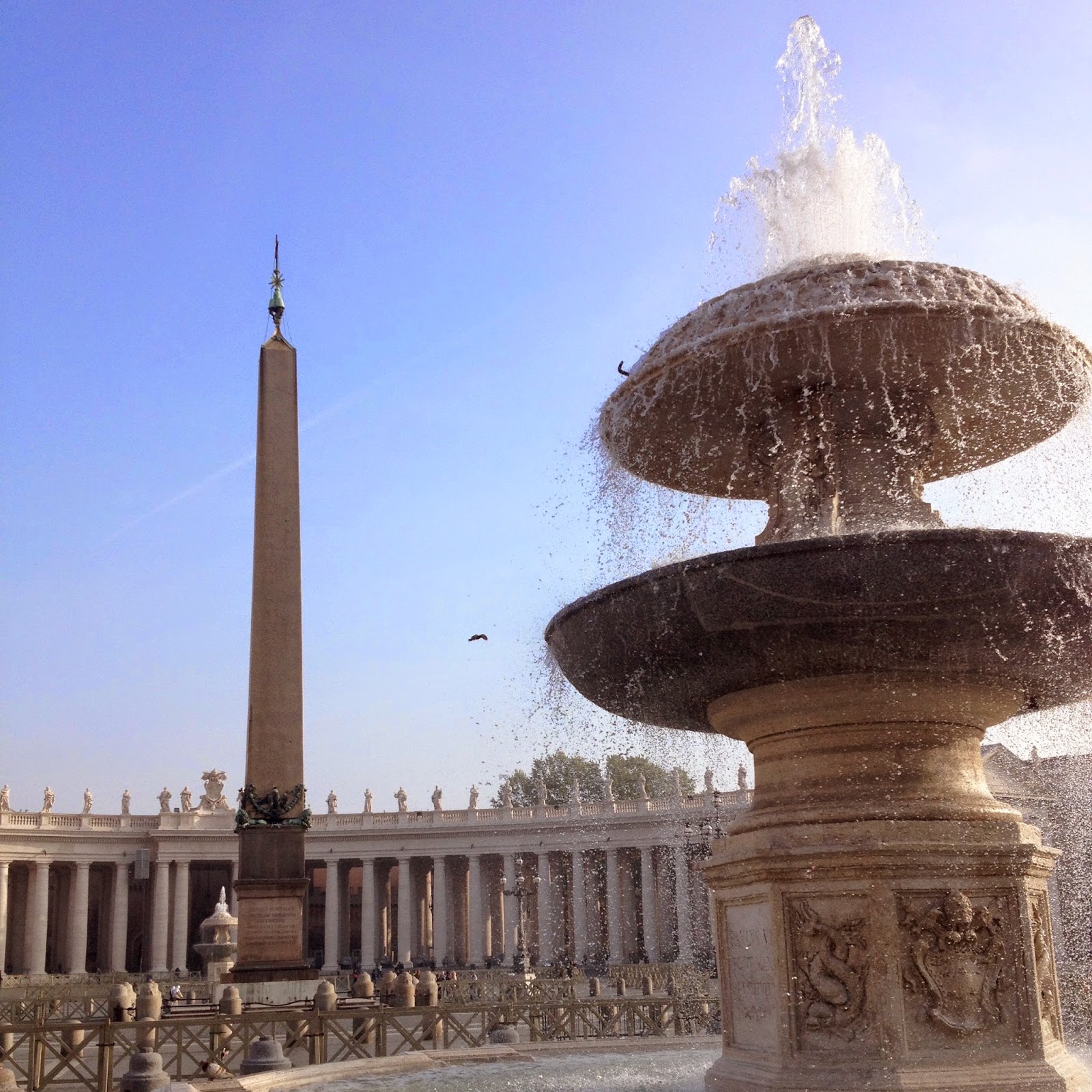
Legion of Mary, in St. Peter's Square!

In your second semester at the NAC you get assigned an apostolate, which usually involves some kind of work in the fields of evangelization or charitable work.  Options are as varied as working with the Missionaries of Charity to feed the poor, to teaching students catechism, to giving tours of St. Peters, to - and this is the one I am blessed to be a part of - evangelizing pilgrims in St. Peter's square as part of the Legion of Mary.  Lets just say, it's an amazing apostolate!

Like any other Legion group (it is a worldwide organization, with "Legions" of Mary at Parishes all over the place), the 10 or so of us meet once a week and pray the rosary, read out of the hand-book (both devotional, speaking about the beauty of emulating and following Our Lady, and practical, as in, how to do that out in the world when trying to evangelize), and go through the reports of what all the members did over the past week.  In our case, the work we do doing during the week is always evangelizing down in St. Peter's Square.  We go out in pairs, for about 2 hours, and just make ourselves available to whoever wants to talk with us during the time.  So, I've been out a handful of times now (I started at the beginning of this semester), with a couple of different guys, and it has had a profound effect on my approach to evangelization, my confidence in approaching and conversing with strangers, and my excitement for the priesthood.  

Regarding evangelization, two factors have made this apostolate a fantastic chance to learn how to take the Gospel out to the world.  Firstly, the other guys that I've been going down there with are great examples - they're zealous, loving, excited, patient, knowledgable, and approachable - and they've taught me a lot about how to jump into a conversation with a random pilgrim in the Square.  I found myself prone to sort of dismiss those who just wanted directions to the Vatican Museum or the times for Masses in St. Peter's; it was easy just to give them the info and send them on their way.  But, as the other guys showed me, evangelization often begins with the most humble of openings - just ask them how they liked St. Peters, or how long they've been in Rome, or where they are from, and boom, things happen.  Like the lady we encountered asking where to buy rosaries - simple, I thought, head down the Borgo Pio and you're set - but instead we started to talk with her, and she started talking about her kids, the trip she was currently taking with her husband, and asking about our vocations and what we were doing in Rome.  We ended up inviting her to the NAC for Evening Prayer, went out for dinner afterwards, and it turned into a profound conversion experience for her and her husband who hadn't been to church in years!  Factor number two: a lot more people have questions about the Church and the faith, than I would have thought.  I guess I figured that most people wandering in and around St. Peters would be Catholics, or at least Christians, coming to the center of Christ's church here on earth.  But, that is not the case at all.  Sure, there are many, many pilgrims who don't have questions about the faith, but an awful lot do!  Is Pope Francis changing the Church's teaching on marriage, abortion, etc? (answer: nope - Jesus taught otherwise.)  Will we have female priests? (answer: nope - Jesus chose otherwise.)  Why are the churches so lavish, yet there are poor people all around? (answer: love of the poor has to be integrated with love of God, beautiful churches aren't antithetical to caring for the poor), Why is Peter this important? (answer: Christ chose him to lead His church, as He chooses every Pope to continue being his vicar until His return).  

The Fountains are Flowing Again!
(they are especially beautiful at night, lit up from below)
Obviously, conversations have gotten a lot deeper than that, and I don't want to leave you with the wrong emphasis by my summary of conversations that we've had.  I've learned that above all it's important to not go into a situation with the idea to argue the person out from their error to the truth.  Yes, apologetics plays a role in the conversations - that's part of proclaiming the truth - but, possibly just as important, is exuding the joy and excitement that comes from following Christ.  People don't like an argument, even if it's convincing, they do like happiness.  Christ offers both: truth and joy, and they do go together, but a glum, argumentative, seminarian doesn't change anybody's life, whereas a person who is excited about the truth does!  (Obviously, with God's help.  That example I gave above truly made me realize this.  I said very little during the multi-hour conversation, yet, somehow, God was able to work through our presence to bring Himself to this couple.)  Being "confident" doesn't mean being macho, and off-putting, it means being willing to share the faith, the relationship with Christ, that I have been blessed to have.  It means showing just how amazing life is when you give it over to Him.  Yep, there are crosses - classes are hard, I don't have enough time to do everything I want (hmmm. maybe it's not all about me...), I'm not perfect, I'm far from home - the cross is part of following Our Lord, but there are so many more blessings!  The chance to be 5 minutes from the Vatican, to play soccer in sight of the dome of St. Peters, to travel around Europe, to delve into the mysteries of the faith, to walk past a dozen beautiful, ancient, saint-filled, churches on the way to class every morning, to start every day with Mass, and spend a couple hours talking with God every day - it's awesome!  Does following Christ automatically mean fun travels and great classes? No. But it does mean fulfillment, the peace of knowing that every moment - good, bad, easy, hard, boring, or busy - is a gift from Him, a gentle reminder to turn to Him and be thankful for His love.  It is challenging, but it is rewarding, and the world doesn't know that those things can go together (they can!)  Evangelization isn't faux-confident, overbearing, pounding-in-the-truths-of-the-faith, arguments; no, it's about living ones life according to Christ and thereby showing just how amazing that is.  This is what the early Christians did (above all in their willingness to die for their faith, confident in Christ and peaceful in knowing that eternal life awaited those who turned their lives over to Him), and they transformed the world!

Last point: Being down there, in the collar, bringing the faith to those traveling through Rome, has made me ever more excited to one day, God willing, be a priest.  Gosh, ordination could be only 3 years away at this point - that's crazy (as in, time is flying by), but it's also exciting!  I can't wait to get back to my diocese and minister to the people there, bringing them the faith that I've experienced here in Rome, the sacraments, an amazing opportunity to encounter our all-loving God, and the inspiration of so many faithful that I've encountered here (that's something that I didn't even talk about in this post, as well as devotion to Mary...  Ah well, it can't be a dissertation.)

So yeah, it's an amazing apostolate and I am so glad that it was the one chosen for me!  So much to learn, so much to see, so much to do - all from, and for, Christ!

My Sister's First Profession

Every month or so we have what is called a travel weekend, which is pretty much what it sounds like - everybody is allowed to travel some place around Europe and experience a bit of culture, food, art, history, nature, or whatever, all while building friendships with other men here and having a chance to get away from the bustle and business of Rome.  So far, I have gone on three such trips - the first to San Giovanni Rotundo (we visited the shrine of Padre Pio, Monte San Angelo, and Lanciano), the Amalfi Coast (we saw some beautiful scenery, and also got to pray before the relics of St. Andrew, St. Matthew, St. Benedict, and St. Scholastica), and this last weekend - which is probably going to be the craziest travel weekend in the foreseeable future, when I got to fly back to Alabama and be there when my sister took simple/temporary vows at the Dominican Monastery of St. Jude.  Needless to say, it was an amazing blessing to be back there, but - as seems to usually be the case - it was a whole lot more amazing than even I thought it would be beforehand!

While I was in Assisi I found out the date that my sister would be taking vows - November 22nd, the feast of St. Cecilia - and, of course, I was excited for her, but I knew that it wasn't very likely that I'd be able to be back for it, not only was it a long trip, and in the middle of the semester, but it was also NAC policy that guys don't go home for their first two years here.  However, then I heard of one of the new men who had gotten permission to return home for one of his sibling's wedding.  I didn't know if the same exception would apply to me, but I was certainly not going to pass up at least trying!  So, at my first meeting with my formation advisor - the priest who, you know, advises me as regards my formation (I meet with him once a month, we talk about how things are going - academically, pastorally, humanly, practically, etc. - and he helps to make sure I'm balancing my time/effort well and gives tips/advise/direction as regards any of the problems that could crop up from studying over here) - I asked if there was any way that I could go home for my sister's profession.  He hadn't ever experienced that question, but promised to investigate it with the "powers that be" (the formation staff here at the NAC).  I hadn't heard anything for a couple of weeks, which I tried hard not to interpret as a sign one way or the other, when I had my meeting with Msgr. Checchio.  He met with all the new men during our first month or so here, and, at least in my case, most of the conversation was him asking how things were going, talking about the process of settling in, challenges that I might encounter, and things that I should focus on during this first bit of time here.  It was a great conversation, he is a wonderful rector, but near the end of the conversation I was surprised and excited when he casually mentioned that "I'm glad to hear you'll be able to go home for your sister's profession."  I'm pretty sure my mouth fell open for about a second while I tried to comprehend what he had just said, and then I rattled something out about how great it would be, and he responded with something about loving Dominican nuns and being happy to give me the go-ahead to return for that ceremony.  I, to say the least, was excited!  I got permission from my diocese as well and a couple of days later dropped the news on my family when we were skyping.  They too, were pretty happy (alright, maybe that's an underestimation...), and dad was also really helpful in tracking down a decent deal on the flights that I would need (and would fit around everything).

So, last Thursday (the week before Thanksgiving), I left class at the Gregorian (Christology is that morning) and power-walked over to the bus stop where I had a ticket to Fiumicino.  Of course, because of some uprising/protest/strike, the bus was going to be like 45 minutes late.  I already was pushing it close to get through the airport, so I was starting to get a bit worried when an Italian lady had the bright idea to hire a taxi.  Five of us (myself, the lady, and three other young ladies) found a cab - I got back middle, as always - and off we went.  30 minutes later, nobody having had the guts to start a conversation, we pooled our money, paid the driver, and entered the airport.  I found the desk I needed, they gave me my boarding passes (after a bit of difficulty), and I made my way through security.  Off to Amsterdam!

Pretty cool, no?
In Amsterdam, having not done much except whiling away the hours of waiting/flying with a couple different books and stuff, I eventually boarded my flight to Atlanta and then settled in for the long flight.  As it turned out, I was right next to a couple who were returning from a trip they were taking with their church to the Netherlands.  We had a really nice conversation about Christianity, the priesthood, theology, the church, celibacy, and several other such topics - it was great!  Not awkward, they were very open, and I really enjoyed it.  After a pretty tasty meal (the food was good and they served wine, which was surprising, and enjoyable), I watched Guardians of the Galaxy, which was not only funny and entertaining, but also relatively clean (always nice when you're not constantly wondering at what point you'll have to turn something off).  Then I spent a bit of time in prayer - not the easiest thing in the world in a plane, but being "up there" lent a different feeling to the experience, so that was cool.  I think I watched another movie at some point, and I spent some time reading some different books (Benedict XVI's Jesus of Nazareth, a book on the Pentateuch, Fr. Gaitley's 33 Days to Morning Glory, and probably a couple of other ones).  The hours slid by and before I knew it we were being served dinner (again, pretty good) and only an hour out of Atlanta.  After an uneventful landing, and a bit of walking through the Atlanta airport (and customs...), I found my last gate with an hour or two to wait before boarding.  Being back in America, I decided to find some American cuisine and after debating about whether a certain burger place was going to be worth it, I just went with Chic-fil-A and got my fill of chicken nuggets and fries.  Again, most of the time was past with a bit of reading and some listening to podcasts and whatnot (mainly homilies and other Catholic stuff) - it's funny, I've only been on a plane several times now, but it was already getting pretty usual.  Soon enough we were boarding and then - only like 30 minutes later - I was in Birmingham.  And, 10 minutes later I was elated to see my family at the bottom of the escalators (that I was riding).  It was so good to see them again!  We stayed up late chatting together and then I dropped in bed - some 28 hours after getting up (it was a really long day). 

One month folks!
The next day, Friday, we checked out a couple of things in Birmingham - including the Cathedral (beautiful - it was a lot simpler than the churches over here, but it had stained glass windows, which aren't very often found here) and a museum of art (which had some beautiful pieces - religious and otherwise - though to some extent I have started to take that sort of thing for granted, so it wasn't quite mind-blowing).  Yeah, it was a fun day, just spent hanging out with the family, and that evening we drove over to the monastery and brought our things into the guest house.  After another short night of sleep (which is getting more and more typical) and another banana (which isn't typical over here; they provide plenty of apples, pears, peaches, oranges, plums, and kiwis, but not bananas), my brother and I met with the priest who was going to be saying Mass.  As I was expecting, it was in the Dominican Rite, which was the Roman/Papal Rite of the 1300s (very similar to the Extraordinary Form, with a couple variations), and as I wasn't expecting, one of the servers was expected to chant the Epistle.  My brother - being the generous, humble guy that he is - let me have fun with that, and after 30 minutes of reviewing what we were doing (how the profession ceremony would happen, what was different, who was doing incense, etc.) and a good bit of practicing on my part (actually, I wasn't that nervous, the tone wasn't difficult and the passage was short), we banged the set of chimes that they use to signal the beginning of Mass and processed out.  The chapel - as often in cloistered monasteries - was set up with the sisters/cloister lined up with the altar and the lay congregation off to the side (like an "L", with the sanctuary in the corner) - and because it was ad orientum, I only had a glance of my sister (in the cloister) and grandparents/uncle (who were in the congregation, obviously, but whom I hadn't seen yet).  Mass was like a Low EF Mass, but with incense, so everything went relatively normally until around the homily.  Right after the Gospel (about the foolish and wise virgins), but before the homily, my sister announced her desire to take temporary profession in the monastery.  It was simple phrase, but she was so excited! 

Before the trip I was excited to be back with the family for a bit, to visit my sister, and to enjoy a bit of American cuisine, but - looking back - this was the best moment!  There was my twin sister, much like those 50 men here who gave their lives totally over to Our Lord 2 months ago, giving her life to God - more officially/completely than before - and absolutely overjoyed to do it.  The homily was great - expounding on the beauty of the cloistered call to chastity, and the idea that kept running through my mind was that of joy.  I had been thinking about my sister's vocation in terms of difficulty.  Entering the cloister is tough, it means giving up a lot, and I thought that for that reason it was a great call.  I mean, we all have to give up something to follow God's will for us - that's the cross - but the cloister seemed a particularly difficult one regardless.  However, my sister wasn't filled with trepidation - at the difficulty - or bravado - at the challenges to come - or even excitement - for the life ahead; she was filled with joy, peace, happiness, and other such awesome gifts of God.  The thing was, where I see challenges to be pulverized (with God's help, of course), she wasn't even looking for the next challenge to be attacked, but instead simply looking at God, and trusting that He would help in whatever might come.  Where I focus on the incoming/upcoming thing to do, finish, learn, grow, or become, she simply focusses on the end goal of all that "doing", which is God, and His will.  I've wondered in the past how some of the sisters you see are always so joyful.  I mean, I'm trying to follow Christ too, but I'm not exactly constantly beaming with joy and excitement...  What's the difference?  They trust God better than I do.  Boom, now I know my next challenge, oh wait...


Receiving the black veil!
Yeah, so not only was it amazing to see my sister taking the next step in her vocation (after the homily she made a couple of promises - to the church, the bishop, the order, etc. - and also received the black veil), but it was amazing to realize that that supernatural joy is truly a gift from God.  Not in the sense that he only gives it to some people, but that only some people take Him up on that offer.  It was a beautiful moment, and one that I will cherish for a long time.  Mass continued as normal - at least as normal as Jesus transforming the host into Himself for our reception usually is - with no major hiccups at any point (oh, the Epistle went fine by the way).  After Mass, in another incredible blessing of the trip, we were allowed to come up to the grille in the chapel (where there is an opening for the sisters to receive Communion) and give my sister a hug.  She was still grinning, as you might imagine, and it was just a blessed moment (the first time my grandparents and uncle were able to visit her in there, so it was especially touching to see them meet her for the first time as a nun!)  After Mass, we got to converse for a bit - during which my sister spoke about her preparation for that big day, how the sisters had kept my coming to the ceremony a surprise till the last minute, and in general, everybody was able to fill each other on what had been happening and congratulate Sr. Mary Thomas (my sister's religious name) on her first profession.  We had a delicious - as usual - lunch provided by the sisters and then got to spend part of the afternoon continuing to speak with my sister. 

Who's the happiest?
I guess, I could prolong this post quite a bit further, droning on about the intricacies of what I was up to, but I won't, because the big things had already happened.  As usual, we struggled to come up with a poem to send back through the turn for the sisters...  Yep, I got to talk a lot with my sister (not another, but still) and we stayed up late catching up as a family (it felt like 5 AM to me)...  Yeah, I had another banana the next morning, and Mass was beautiful again (as was all the prayers that we were able to join the sisters for), and saying good-by to everybody was hard (though we did enjoy a 5-Guys burger before parting, which was about as American as it gets).  Of course, the flights were long (Spiderman 2 wasn't as good as I was hoping, but I got a tiny bit of sleep in and a bit of praying/reading in), and the airports somewhere between exciting and exasperating.  But the trip ended on a good note because the busses were running from the airport, and - annoyingly, but mostly amusingly - the wheel on my bag (with chocolate chips and BBQ sauce inside, among other things!) decided to self-destruct mid-way back to the NAC (approximately when I was passing St. Peter's), and, when I went over to St. Peter's for Mass (it was now Monday, because of the time-traveling that I had been doing..., so I hadn't been to Mass yet), I found that it was the funeral Mass for Cardinal Angelini.  I was pretty much a zombie standing there (I was going on 30 hours without much sleep - I would have never imagined they could make a seat as hard to fall asleep in than those on airplanes), but it was pretty obvious I was back in Rome.  Mass in St. Peter's, Swiss Guards, tourists, the mad rush for Communion, hearing Italian...  Va bene!

Super recap: Flying on planes can be fun, American food is still great, seeing the family after a couple months is even better, and God's grace in action, in my sister, is amazing!  The whole experience fit really well with Thanksgiving (which we are still celebrating here at the NAC - with tons of food, football, and the new/old-man shows); it truly reminded me what I am most thankful for.  Yep, being here in Rome is awesome, the food is great (here and back home), and I'm enjoying myself immensely, but life is about so much more than that!  It's about being thankful to God for His much more precious gifts: tremendous friends (here and in America), an amazing, loving, supportive family, and a call from God Himself, to follow Him, to love like Him, to give like Him, and thereby live with Him forever (starting now!)  Tremendous, right!  Thanksgiving indeed! 

Photos in the monastery from their website, otherwise from myself...  Please keep all the sisters in your prayers, especially as we begin the Year of Consecrated Life tomorrow (with the beginning of Advent!)


A Day in the Life at the NAC

About a year ago I wrote an entire week of posts, basically just describing what the day-to-day life of seminary involved at Brute.  Well, now I'm in Rome, at the NAC, and I figured that you guys might be interested in the day-to-day happenings here.  I've only been able to write a few posts so far unfortunately, and I found that I really wasn't speaking to much on what the usual life here is like - I either talked just about one little moment or like an entire month, neither of which really tells you what the typical day is all about.  So, without further ado, here's today:

So, this morning the alarm went off at 5 AM.  Unfortunately, I stayed up till midnight last night working on a paper that's due in my theology seminar tomorrow and skyping the family (a seven hour time differential wreaks havoc with communication), so I woke up pretty tired.  Nevertheless, after quickly shutting off the alarm, I creaked down from my bed (I have a loft, which is great, but it does shake a bit when I move around on it), and proceeded to try and wake myself up by doing this "seven minute workout".  It's an app that I found for my phone that times out thirty second intervals during which you do push-ups, jumping-jacks, crunches, lunges, or whatever.  So, seven minutes later I was breathing a bit harder, just about to start sweating, and very much awake.  I turned on a podcast - this one happened to be Fr. Fessio on Catholic Answers Live - and proceeded to get dressed (in clerics! - which is still pretty cool even after wearing them every day for a month or two), brush my teeth, shave, and do those other things that are necessary each morning.  10 minutes later the podcast was paused, I grabbed my breviary, a prayerbook, a notebook, and Scott Hahn's The Lamb's Supper, and rattled down the 6 flights of stairs to the chapel.  It was now about 5:30 and I spent the next 45 minutes doing the Office of Readings, meditating a bit on the readings for the day, reading a chapter on the Mass out of Scott Hahn's book, and just spending some quiet minutes preparing myself for Mass and offering up the entire day to God.  I was certainly tired, but not to such an extent that prayer was impossible, and there was something beautiful about just telling God that - despite everything - I was going to try and give Him my best today.  Nothing spectacular on my end, but a good start to the week nonetheless.

Morning Prayer began (in common) at 6:15, followed by Mass, and - I have to say - I wasn't struggling quite as much as I thought I would based on the amount of sleep I got last night.  I think the time change (which happened last weekend here in Rome) helped because it is now light when we come out of the chapel after Mass (which was a happy surprise this morning, but probably something that unconsciously was helping me stay awake).  One of the deacons (I hate to say it, but I didn't remember his name and I forgot to look it up) gave a very good homily on how Jesus intended to heal the woman on the Sabbath because He is the Logos, the Word made flesh, through Whom the world was first created, and His salvific mission is to bring God's creation back into right relationship with God.  Brokenness, sinfulness, hatefulness, sickness - and every other kind of evil - weren't there when God created the world - He created it good.  But through man's choosing themselves over God - in sin - evil enters the world, and the world becomes twisted, broken away from God.  Jesus enters to bring the world back to God (and radically bring God into the world).  He heals, not to disregard the Sabbath, but to bring mankind to true rest, apart from sin, in union with God.  And, of course, He invites us to that same rest, that same union, every day in Holy Communion!  

After a couple minutes of prayer following Mass I walked down the hall to the refectory for breakfast, which, this morning anyway, involved leftover cornetti (sweet croissants) from yesterday, hard boiled eggs, and some yogurt/cereal/plum concoction.  15 minutes later - after chatting with some guys while eating - I charged up the 6 flights of stairs to my room, spent about 10 minutes getting ready for class, and then grabbed a jacket (it was in the 50s this morning), headed back down the stairs, and out onto the streets of Rome.  Originally, I began my walk listening to another podcast (gotta spend every moment wisely!) and studying the Hebrew alphabet (not terribly easy to do simultaneously), but after about 10 minutes I ran into some other guys on the way to class and so we spent the rest of the 30 minute walk talking about Rome, classes, plans for the rest of the day, and other such things.  It's funny how quickly I got used to walking over to class - it's crazy to think that I get to walk past the Piazza Navona, Santa Maria sopra Minerva, and the Pantheon every day on my way to class!  Fun times!

I arrived at the Greg. (Pontifical Gregorian University - if you want the full name) at about 8:20, with just enough time to head up the 2 flights of stairs, get settled into my desk, and log into the wifi before class began.  Classes are all in Italian - which, today as always, was a struggle.  We had two hours of Pentateuch and then 2 hours of Church History, both divided into two 45 minutes periods with a 15 minute break in between.  I am always very glad when the raucous bell goes off (it really does make a racket) and we get the break because it offers me a chance to clear my mind, stretch a bit, pray a bit (there is a very nice chapel up on the 3rd floor), or otherwise relax a bit - a very necessary thing to do because after 45 minutes of struggling mightily to translate what the professor is saying and type it out, my brain is usually pretty much fried and very ready to get distracted.  Classes have been getting better over the last 3 weeks, I guess I'm picking up new words and getting faster at translating, but I am very glad that guys better at Italian than myself are taking notes (that we then share) because otherwise, I'd be left with only about half of what we talk about in class.  Speaking of which, today we finished talking about the flood and began studying the tower of babel - and how God constantly tries to return man to His loving plan for creation, and away from mankind's tendencies to try to make himself God, and take the easy road to happiness, power, glory, or whatever.  In Church History we talked about the persecution of the early church - the writings of the Church Fathers at that time (St. Justin, St. Ignatius, St. John Chrysostom, etc.), other sources we have of that period (The Acts of the Martyrs, The Letter to Diagnetus, etc.), and the reasons behind the persecution and the phases it went through under different emperors.  That class, in particular, I'm going to have to rely on the notes because while there were PowerPoint slides (which are much easier to translate than simply an oral lecture), they each had about a thousand words on them - so it seemed - so I usually got about half-way through the slide before he flipped onto the next one...  Anyway, piano, piano (slowly, slowly).  In between the first and second period I took like a micro-nap (first time I've ever done that), which actually helped a ton with staying alert for the rest of the time, for the second break I spent some time in the chapel (again, dedicating the work of the day to Our Lord), and I think I just talked with some of the other students for the last break (there are probably about 80-100 students in the class, 20-something of which are from the NAC, and all the others are from other universities or orders around Rome, most of which don't have English as their first language, or Italian, so that can be a struggle at times as well - ah well, we keep trying!)

The walk back was beautiful!  It was just warm enough to not need the jacket, and it was just cool enough to not start sweating on the hike up the hill to the NAC (we're located on the Janiculum hill, one of the 7 hills of Rome).  As always, the streets are busy in places (mainly with people, we actually only have to worry about cars at a couple of intersections), and there are many people stuck in poverty who we always try to give at least a "bongiorno" and a smile.  I'm still getting used to both groups, and trying to constantly remember to be not only polite, but kind and loving - even if only for the moment.  It's one of those things, wearing the collar constantly reminds me of my call - especially as a seminarian - to live, and love, like Christ, which is a constant challenge, especially when you'd really rather just hurry back and get some lunch than stop and give somebody directions, or struggle to communicate your compassion to that homeless lady who always calls out to you as you walk past.  It's a real challenge, one that I didn't expect, and one that I need to constantly take to prayer!

Today, for the first time, I served at pranzo.  That basically means that instead of saying the Rosary like I usually do upon getting back (there's about 20 minutes between us getting back and pranzo), I instead headed into the refectory and started to set out jugs of water and bowls of salad on all the tables (36 tables, 2 jugs each, and the water-machines are pretty slow - it takes a while even with a couple guys working on it).  Then, after about 10 minutes we started carrying back salad plates and carrying out trays of pasta (today was noodles with a creamy red sauce and little flakes of ham - really good but I have no idea what it was called).  20 minutes later, the process repeated, this time carrying back the plate used for pasta and bringing out the secundo (today it was roast beef of some sort with tomato sauce along with peas).  And, a couple minutes after that it was time to carry out bowls of fruit (the dessert for today) and continue to clear plates and stuff.  I would have thought there would be down time, but there wasn't.  I was constantly on the move, going to fetch more food, or cheese, or water, or trying not to drop a stack of plates and silverware (always a balancing act).   Either way, at 2, everybody finishes up, the waiters sit down at their own table, and then we get to eat our own pranzo (same as everybody else's, but we just wolfed it down, and headed off to get things done that afternoon).  It was a fun first time - not hard, not easy, not bad - yeah, actually kind of fun!

I spent the next two hours in the library, working on the process of note-redacting.  Basically, because I'm not one of the chosen note-takers, I have the other job of taking the notes from three different guys for one of our classes (Introduction to Scripture) and combing them all.  The goal is to then have a pretty complete set of notes for the class which everybody can then use to fill in the gaps in their own knowledge.  I thought the process would be easy - boy, was I wrong.  It was such a challenge to look at the 3 or 4 different sets of notes, figure out when they are talking about the same thing, and then combine them in such a way that you lose nothing of any of their meanings but don't repeat anything at the same time.  It was way more of a challenge than I anticipated, and it took all two hours I had open in the afternoon (which I was hoping it wouldn't).  Anyway, such is the way it worked out - I'll have to find more time in the future to do it - but for today, I didn't have any more time!  After struggling to get the computer to save (the network wasn't working quite right) I raced out of the library, down to the St. John Paul II class-room (we don't usually have classes here at the NAC, but they do have some rooms for the occasional lecture or something I suppose), where I attended a meeting of the Legion of Mary.  

I was in the active Legion back at home, before seminary, so the meeting itself wasn't new, but I wanted to check it out as a possible apostolate for next semester because their work sounds really, really cool.  Basically, next semester I'll have an apostolate - which could be helping at a nursing home, working at a soup kitchen, visiting a prison, leading tours of St. Peter's, or - another option - doing evangelization in St. Peter's square for the Legion of Mary.  It sounds really fun actually - standing out there, meeting and greeting tourists who come there and answering any questions they have about the basilica, the Church, Christ, His saints, or any of the other innumerable questions that come up when you visit Rome.  It's an easy opportunity to lead people to grow deeper in their faith (or understand the importance of faith), and I will probably put it as one of the apostolates that I'd like to do.  We'll see, I'll be actually trying out the work in the square on Wednesday, so I guess I'll have to wait till then to be sure.

Anyway - running from one thing to the next - I charged back up the 7 flights of stairs to my room (I was in the basement), grabbed my Breviary, the Bible, Benedict XVI's Jesus of Nazareth, and the Magnificat and headed back down to the chapel for an hour of Eucharistic Adoration.  I got there just in time for it to start at 5:45 and spent the first bit of time just quietly adoring Our Lord, and then meditating on the readings for tomorrow and the psalms for mid-day prayer.  It was tough to strike the balance between quieting my mind and not falling asleep, but I did fairly well today!  I read the chapter on the Kingdom of God today from Ratzinger's book, which was absolutely beautiful.  He explained how the "Kingdom of God" isn't just a individual relationship with Christ, and it isn't just the Church, and it isn't some sort of earthly kingdom which holds Christian principles or something - rather, the "Kingdom of God" is Christ Himself.  Yes, present within us, and His Church, and throughout the world - but fundamentally, when Christ announces that the Kingdom of God is at hand, He is announcing Himself, living, incarnate, actual, moving, loving and desiring that we open ourselves up to Him and allow Him to reign over our hearts, our lives, our families, our decisions, our countries, and our world!  Something that Pope Benedict didn't mention, but I was graced with the thought a couple minutes later during Benediction, was that in the Our Father, Jesus tells us to pray "Thy kingdom come, Thy will be done, on earth as it is in heaven" - obviously indicating that we should strive to accept, to unite ourselves with, to do, God's will (that He may reign over our hearts - where He truly wants His Kingdom to come), but the very next line - drum-roll please - is "give us this day our daily bread".  Again, boom, it struck me of the incredibleness and importance of the Eucharist.  It is in this "daily bread", this supernatural bread, that Jesus gives us Himself.  Our "Amen" to receiving "the Body of Christ" is not only our statement of belief that this is "Christ the Son of the Living God", but also that we are willing to unite ourselves with Him so closely that He can enter our very hearts and souls.  With our reception of Holy Communion, we let Christ reign over us, we surrender to His will for our lives, we let His kingdom come!  Yeah, that was a pretty awesome moment! 

After doing Evening Prayer as a community, and saying another quick little prayer of dedication and thanksgiving, everybody headed off to the refectory for dinner.  I chose (it is buffet style) to have a little bit of pasta (shells with a cream sauce), some slices of turkey in gravy, a salad, and a banana with peanut butter (we rarely have bananas here, at least right now, so it was a treat!).  Again, nothing outrageously amazing, but it was all good, and hot, and there were good conversations to be had, and there was a banana!  

Alright, the day's almost complete!  After dinner I ran back up to my room, spent a bit of time on writing this post, worked for a couple minutes on Hebrew (I need to spend so much more time on that), and then went down and caught the last 30 minutes of a praise-and-worship hour that happens here once a week.  I had rarely done that sort of things before this semester, but there is something beautiful about that way of singing and praising God - I guess I didn't expect to like it, but in the right context it is beautiful, powerful, and prayerful!  Then, continuing to run to the next thing, I watched one episode of Agents of Shield, a TV series based off of the Marvel comic strips and films.  It's actually quite a good show - without too much language or other kinds of vices, but showing a decent amount of action and some seriously difficult moral decisions (which they don't always make the right choice).  You know, a couple super-hero's, good guys fighting bad guys, it's fun!

And now, I'm finally finishing this post, getting ready to post it and hit the sack (currently, I'll be getting 5 hours and 56 minutes of sleep tonight... - not enough, but it'll have to do).  It was a long day, I literally didn't have more than a couple minutes anywhere when I wasn't doing something or onto the next thing, but - as always - God provides and "tomorrow will worry about itself".  I recall hearing of a priest saying that he wanted to be tired each evening - spending himself for God and his flock - and I was inspired by it!  Don't we all want to really give our lives for something that's worth it!  But, I was kind of assuming that he woke up every morning having gotten 8 hours of sleep, with the sun shining, and a game-plan of what amazing things he was going to do that day.  Apparently, yeah, God is asking me to give myself - day-in-day-out - to Him, but that means being tired when you go to bed, and when you wake up!  Hmmm...  Something about picking up one's cross comes to mind - I guess I should have expected a bit of tiredness, frustration, business, and the daily grind.  Ah well, again, God will provide - it's an amazing life, if busy, and I'm loving every minute, even if exhausted!

Reminders of God's Will in Assisi

So this morning I got up around 6 (which seems to be the schedule that I am settling on for my time here in Assisi) and after a quick shower headed down the hill (5 minute walk) to San Stephano, a tiny little chapel where we have been having Mass as a group (in English) for the past week and a half.  Fr. Kevin, a priest who happens to be studying Italian with us, is kind enough to make the walk in from where he is staying outside Assisi a couple hours earlier each day to offer Mass for us.  Well, this morning, I read the readings before Mass and was kind of wondering how (or if) he would pull together St. Ignatius of Loyola - the founder of the Jesuits - with Jeremaiah - who speaks on God as a potter, forming us like clay - and Jesus - who tells us today in St. Matthew's Gospel that the Kingdom of Heaven is like a net full of fish, both good and bad. 

Thankfully, Father is a wonderful homilist - not long winded, but adept at pulling many seemingly disconnected things together and keeping it interesting at the same time.  Well, I wasn't dissapointed.  He began by speaking on the painting by Rafael of the Gospel passage, of this catch of fish at the end of the world, of all the nations being drawn to Christ.  This painting, as it turns out was comissioned by Leo X, who, through his extensive patronage of the arts back in the 1500s, bankrupted the Church to such an extent that they were hardpressed to find candles for his funeral Mass!  Moving into the first reading, Father reminded us that we must completely abondon ourselves to GOD's will, not our own.  Like St. Ignatius, we must convert, we must open ourselves to God's plan, a decision that takes things out of our hands and puts them into Christ's.  Obvious right?  Well, this means living like St. Ignatius - falling in love with Christ in the midst of his pain, deciding to turn his life completely around, not trying to plan his own vocation but instead letting God take command and just going where God took him (first to the Holy Land, then Paris, then Rome).  We must, as it says in the Gospel, let God "haul us ashore, put what is good in buckets, and throw away what is bad" [Paraphrasing Matthew 13].  God must do the molding, not ourselves!  As the life of St. Ignatius shows us, God uses mysterius means to bring us to Himself - for Ignatius, it was a cannonball that ended his promising career in the military and landed him in a hospital where he could only read about the lives  of Christ and the saints.

We must ask ourselves what clues (or maybe less subtle reminders) that God has put in our lives every day of the places where we are failing to open ourselves to Him, where we aren't committing ourselves to His plan and are instead trying to follow our own.  Pope Leo 10th was following his own plan when he bankrupted the church - did we end up with some great art? - certainly, but was that God's plan? - probably not (though, of course, God brings good out of it).  I am reading "Intoduction to the Devout Life" by St. Francis De Sales, and, as it often seems to happen, what I was reading today seemed to mesh really well with everything that was happening this morning.  He is speaking on devotion, how it is the perfection of love in our hearts (surely God's will for all of us) and he noted that those who lack devotion - those of the world - do "not see the interior and cordial devotion which renders all these actions [fasting, prayer, patience, generosity, stifliing the passions, and all the other virtues] agreeable, seet and easy."

Basically, Our Lord wants to mold us like Himself, He wants to recreate us in His own image, and the only way that can happen is if we are totally open to His will, totally available to His work, totally willing to submit ourselves to whatever He has planned for us.  All the saints are great examples of people learning this abandonment.  I am reading "To Whom Shall We Go?" by Cardinal Dolan on St. Peter and I am in the chapter about Jesus' threefold request of Peter whether he loves Him.  Our Lord asks us the same thing today (and every day): "do you love me more than these?" - more than worldy pleasures, more than friends and family, more than your own will for yourself?  It's a hard task to say "yes Lord, You know that I love You."  It's hard in our culture to not deny Christ in some way each day!  BUT, the saints offer us great examples of what great things happen when we follow Christ.  They show us that it is a sweeter, more wonderful, more peaceful, and more joyful life when we abandon ourselves to Christ's will (He knows better than us what will make us happy).  Let us strive then this day to see God's will in everything that happens, and better try to discern what He wants us to do - of course, based around opening ourselves to His love.

With that, off to 6 hours of Italian studies - I guess I need to figure out where that fits into God's plan for me!  Sorry for the complete dearth of posts lately, I've been busy!  (I'll work on it though!)  Everything was awesome in Rome, everything has been more peaceful, but has entailed more work here in Assisi, and in pretty much everything I've found myself growing closer to Our Lord, especially through His saints, and all the other guys in my class, who are a fantastic group of guys!  Bon Giorno!

Hope Springs Eternal (literally)

I have a summarized recap at the end, if this wall-of-text is too much for your little bit of free time (or limited attention span)...  :-D

Last week, on Tuesday, most of the guys at Brute (including myself), went over the St. Nicholas Catholic Church in Sunman, IN, to attend the funeral for a younger brother of one of the guys who had tragically died a few days before.  We had received word about a week before, right after the senior tribute night, and had all gone up to the chapel and prayed a divine mercy chaplet for the young man who had passed away, as well as for Joe and his family.  The funeral - like that somber night - was also a powerful moment, showing the fraternity and concern present among all of us at Brute.  It was the middle of finals week but just about every guy figured out a way to reschedule his finals for that day and cut time out of studying or sleeping in order to ride the hour and a half to be present for the funeral. 

But, that is not what this post will be about (though it could be).  What I want to talk about is what Fr. Shaun Widdington spoke on in his homily.  The Gospel was about the death of Lazarus and how Jesus waited 3 days before coming to Bethany and raising Lazarus from the dead.  Father spoke on how often-times in the midst of loss, or pain, or suffering (of all kinds, but especially the poignant suffering that accompanies the death of someone we love) we feel like Jesus isn't there, or we don't understand why such-and-such a loss has befallen us, or we think that there is no purpose for this suffering.  As Father explained it, often-times in this life we find ourselves on Holy Saturday.  We often live through excruciatingly painful moments, our own Good Friday's, but we are unable to find hope, or purpose, or God, in that moment.  And then Father said something profound (for me), he said that Jesus Christ is our hope, in His resurrection we find the promise of our own resurrection, in his coming back to life we find God's promise to those who love Him of eternal life.  This wasn't profound because I didn't know it, rather, it deeply impacted me because it reminded me that our hope must be in God, in eternity.  Often I want to figure out how suffering in this life can be transformed, and thus eliminated, and surely that is a possibility - the cross is our standard of victory precisely because through the cross Jesus conquered sin and death and ransomed us so that we can become sons/daughters of God - but sometimes suffering doesn't seem to have a point, oftentimes we can't see how God can bring good out of suffering.  Father, in his homily, reminded me that as humans we often can't find the good in a particular event - we can't see how the untimely, unexpected death of a young man can possibly fit into God's plan or how He could possibly bring good out of it.  Our sight is limited, even when we look at the cross and see how God brought good out of it, we glance back at our own lives and still feel lost, forgotten, even abandoned.  Father reminded me (and I needed that reminder) that our hope must - in the end - rest in heaven.  Sometimes we will never understand why some suffering, or some difficulty, or some loss has happened to us, at least not until heaven.

Why is this?  Why do we sometimes find ourselves in the darkness of suffering and can't feel the light of Christ?  Well, this morning in the office of readings I was confronted with precisely that question.  The first psalm (Psalm 44) talks of trusting in God:
It was you who saved us from our foes, it was you who put our foes to shame. All day long our boast was in God, and we praised your name without ceasing.
But then in the second psalm the psalmist finds himself lost, seemingly abandoned by God:
Yet now you have rejected us, disgraced us: you no longer go forth with our armies. You make us retreat from the foe and our enemies plunder us at will. You make us like sheep for the slaughter and scatter us among the nations. 
And in the 3rd psalm his confusion grows worse because he have been faithful, he hasn't forgotten God, yet he feels crushed beneath the oppression, suffering, and death experienced in this world:

This befell us though we had not forgotten you; though we had not been false to your covenant, though we had not withdrawn our hearts; though our feet had not strayed from your path. Yet you have crushed us in a place of sorrows and covered us with the shadow of death. Had we forgotten the name of our God or stretched out our hands to another god[.] Would not God have found this out, he who knows the secrets of the heart? It is for you that we face death all day long and are counted as sheep for the slaughter. Awake, O Lord, why do you sleep? Arise, do not reject us for ever! Why do you hide your face and forget our oppression and misery? For we are brought down low to the dust; our body lies prostrate on the earth. Stand up and come to our help! Redeem us because of your love!
Sometimes we feel the same way.  Life is going along smoothly, our relationship with God is alive and well, we are progressing in virtue, filled with His joy, and then something terrible, painful, or difficult happens and we feel like we've lost contact with God, we can no longer see His plan in the midst of the suffering that has afflicted us, or worse, we feel abandoned or forgotten by God.  

As I was reading these psalms, my mind went back to the homily that Father gave at the funeral, and how he ended with the difficult truth that true happiness is only found in the next life.  Sometimes we can't understand suffering.  Sometimes things do look hopeless, but Christ calls us to continue hoping in Him.  Sometimes we are stuck on Holy Saturday for a long time, sometimes the tomb looks sealed, and no matter what we do we just can't figure out where God's plan is at.  This is the problem of evil, the question that we have of how God - if He is good - can allow bad things to happen to us.  We can philosophically say that evil exists because of free will - we bring it upon ourselves.  We can theologically say that God loves us so much that He was willing to give us free will - knowing that we would sin, bringing that suffering upon ourselves - and suffer and die to bring us back to Himself.  We can spiritually say that suffering comes from our lack of love of God - of choosing something else over Him, which will never fill the need we have for God, and thus, we experience pain.  But sometimes those explanations don't seem to cut it.  Sometimes we can't figure out why a certain loss - maybe the death of a loved one, or an illness, or a spiritual emptiness - has befallen us and we certainly can't see how God can bring good out of it.  

In this difficulty the answer is again found in Christ's resurrection.  In this time after Easter, when we get to constantly celebrate the awesomeness of the resurrection, we are called to remember the entire paschal mystery, Christ's passion, death, and resurrection.  They all go together, and they all point us towards our hope that is in eternal life with Him.  We aren't promised earthly happiness, actually we are asked to pick up our cross, but - if we are faithful - we are promised eternal happiness in heaven.  The wonderful truth of Christianity is that we are made for a happiness which only is found beyond this world.  As Augustine says, our hearts are restless until they rest in God; no earthly pleasures, or stuff, or peace, will ever be enough for us.  Even if we could avoid earthly suffering (which we can't), we are made for something more, we are made in the image and likeness of God and He offers us eternal bliss with Him, not anywhere else.   But this promise of future happiness is precisely something in the future, and the road there may be twisted and rocky.  Sometimes following Christ seems easy, fun, and exciting,but sometimes it is not - the road is often narrow.  

In all of this it seems difficult to remain positive, but we must always remember that our hope is in God, not ourselves.  If we rely on ourselves to figure out why some suffering has struck us, at some point we won't be able to figure it out and then we are left in despair.  But this despair is exactly what happens when we lose hope in Christ.  Hoping in Him, in his promise of eternal life and eternal happiness, requires us to not rely only on ourselves and to trust in God.  God promises us an eternal, complete, beyond-this-world happiness, and that requires that we trust in God, who is beyond this world.  You can't have it both ways; you can't have eternal happiness in a temporal world; you can't accept the gift of Heaven if you think you can create it for yourself on earth.  Earthly suffering can be transformed when we view it with the eyes of faith, but it also can be accepted - even when we don't see how it can be transformed - through that same faith which shows us the beautiful promise of heaven.  

Look at Mary.  She is a humble, beautiful, and holy young lady, and then an angel appears to her and asks her to become the mother of God.  She doesn't understand, yet she accepts (trusting in God, not herself).  And despite this intense trust that she shows to God - beyond anything any of us have ever done - she experiences a life that is chock full of terrible sufferings.  She is told that sword will pierce her heart, she has to flee into Egypt to escape Herod, she loses her Son in the temple, she watchers her Son get beaten, condemned to die, carrying the cross, and then crucified, she is at the foot of the cross, watching the life drain from her divine Son, and then He dies.  Her grief is impossible to contemplate, her pain, difficult to think about.  Of course, her life wasn't all pain and suffering - surely there were moments of peace, love, happiness, fun, etc. - but what I realized was that Mary, the holiest human ever (besides Jesus), wasn't exempt from the sufferings that afflict us all, if anything, she experienced more of them.  What gives?  That doesn't make sense to us.  

But if we look at the entire picture, including eternity, we suddenly find hope, and joy, and happiness again.  Despite all that pain, what is Mary given? - the queen-ship of heaven and the most perfect joy - having both body and soul - in paradise forever!  For a long time I didn't really know why the last two glorious mysteries of the rosary - the assumption and coronation of Mary - were there.  Yeah, they were teachings of the church, but they didn't seem to fit into the scope of the other mysteries, which are all about Jesus' redemption of mankind.  But now I have realized that it is in the light of the assumption and coronation that we realize the scope and grandeur of heaven that is bought for us through Christ's incarnation, passion, and resurrection.  Mary, as always, brings us closer to Christ!  In her, we see - in its entirety - Christ's promise of eternal life.  We are called to the same trust and faith in God - even in the midst of intense sufferings - that Mary had.  We are promised
 the same intense joy - if we remain faithful - that Mary has.  

Now, looking back through this post, there is some sense that this is a bit of a downer.  There is something very enticing about the Gospel of prosperity that claims that Jesus came so that we might have earthly wealth and happiness.  But if we really think about it, salvation must be so much more than that.  If salvation was all about bringing us earthly joy then it isn't very valuable - we can try to get earthly joy on our own, without God becoming man.  No, salvation involves saving us from sin, and death, and hatred - not from earthly troubles.  Salvation is a promise of perfect happiness, not the imperfect kind that we try to find on earth.  Now, this isn't to say that suffering and pain are good things; certainly they aren't; they came with the fall.  But, the paschal mystery invites us to lift our gaze, to have hope in the eternal life prepared for us, to see that the "life in abundance" promised us by Christ is so much more than earthly abundance.

Alright, time for a recap and conclusion:  Sometimes we find ourselves on our own Holy Saturday.  We experience loss, pain, hatred, doubt, or death and we don't know why.  Of course, we can always offer it up, and try to grow to love God more though it, but sometimes even that doesn't make it any easier to bear.  Sometimes we feel empty, abandoned, forgotten by God - we feel despair - and we don't know what to do.  But in those moments, above all, we must remain steadfast in our hope of eternal life.  Sometimes we will experience earthly suffering, and often those struggles won't go away; we can't see how God could transform them into something good.  In those moments, we must lift our eyes to the promise of life to come, to the eternal happiness that awaits us if we keep the faith.  Yes, struggles will beset us - and sometimes they don't go away (at least, for a long time), but through it all we must struggle to be like Mary, trusting through everything, knowing that God promises those who love Him bliss in heaven, not on earth.  

Now, all that said, don't think I'm experiencing some terrible crisis or anguish or something - I am doing just great at the moment (having fun with the family, planning for vacation, getting stuff ready for the NAC, etc.), but over the last week or so I have continuously been struck with ideas regarding the fact that our hope must be in heaven, not in ourselves, or on earth.  But, God gives us this hope in an incredible way.   As the prayer for the end of the Office of Readings for today says: 
God our Father, life of the faithful, glory of the humble, happiness of the just, hear our prayer.  Fill our emptiness with the blessing of the Eucharist, the foretaste of eternal joy.  We ask this through our Lord Jesus Christ, your Son, who lives and  reigns with you and the Holy Spirit, one God, for ever and ever. 
Our hope, then, isn't even as far removed as Heaven.  Jesus gives us His divine hope, and love, and joy in giving us Himself in the Blessed Sacrament.  This is the promise of eternal life, and the gift of that divine life into our souls, and that which gives us strength for the journey...  Yeah, the Eucharist is everything, because it is Jesus Himself.  Struggling? - spend an hour gazing at our Lord in the Eucharist.  Empty? - receive the fount of all grace in Holy Communion.  Hurting? - accept the token of Jesus' immense love for you in His Body and Blood.  Happy? - thank the Lord of joy for that gift.  Does the Eucharist take away suffering? - nope, but it gives us the strength to carry our crosses, the joy of intimate union with Christ, and the hope of eternal life with Him forever.  

And that's all for now!  Thanks for reading!

The End of the Semester and Trusting God with the Future

Well folks, I just finished college!  I managed to survive Monday (which entailed finishing a paper at 2 AM, and knocking out two tough philosophy tests), and then must of us went to the funeral for Joe's brother on Tuesday (hopefully, I can get together a post entirely on that day), so I then had to make up the New Testament test (not too hard because I studied enough for it) and logic (also easier than expected) on Wednesday.  After that, the only final I had remaining was the take-home essay for modern and contemporary philosophy, which was pretty easy (only a few pages long) and only took an hour or two.  

Of course, the difficulties, successes, and completion of finals week isn't enough of a topic for a post regarding the end of the semester and the end of my college career, so I guess I'll spend the rest of this post talking a bit more about the whole experience so far.

To be honest, I've thoroughly, completely, utterly loved seminary over these past two years.  I was scared out of my wits when I showed up, but within hours I had begun to feel the vibe, the energy, the joy, and the intensity of seminary - and I fell in love.  I can't begin to express how wonderful of an experience it has been.  I have learned more than I thought possible - about philosophy, about life, about friendships, about discernment, about faith, about love - and I've enjoyed every moment - including the hard ones, like tests, and dry periods in prayer, and situations that forced me out of my comfort zone, and the awesome ones, like playing in the soccer tournament, those beautiful moments in Mass where everything clicks and it really feels like heaven, going out to eat with some of your best friends, watching countless great movies, spending hours of supreme peace in front of the Blessed Sacrament, study groups.  Yeah, every moment has been phenomenal!  

And now it's all about to change...  On the one hand, I'm excited.  Not only to graduate and enjoy the feeling of completing college, but also to head home (spend some quality time with the family), and then in July to head over to Italy to begin a new (and awesome) chapter in my seminary "career".  Yeah, I'm looking forward to all of it.  But on the other hand, I'm going to miss Brute.  I love the fact that I have a genuine friend in everybody here - something that is going to be much harder when I'm at the PNAC with 250 other guys.  I love the laughter, and music, and singing, and craziness that echos down the halls - this truly is a fun place!  But, on the third hand (whatever that is...), moving on is a bit scary.  Studying in Rome will be fantastic, but it will also be a struggle.  I'll be a long way away from all the great friends I have (here at Brute as well as at home), and my wonderful family - that's hard, it's a sacrifice I wish I didn't have to make...  Most of the guys here at Brute have been moving out yesterday and today and it finally hit me that I won't be seeing a lot of these guys in the near future - it's a happy moment (the semester is over!), but it's also sad.  In 2 months (almost exactly) I'll be doing the same thing with my family and friends back home, and that will be an even more exciting, and even more difficult, moment.  

Still, I'm putting it all in God's hands.  Lord, lead me where you want me, give me the strength to endure the hardships that your vocation entails for me, and grant me the true joy that comes with following You.

The second half of my New Testament final was an exegesis essay on Luke 2:25-35 (the presentation in the temple and Simeon's canticle).  I talked about how Luke's Gospel, all the way through, is looking at how true joy (from God) only comes through a certain amount of suffering, often in self-sacrifice and trusting Him.  Zechariah and Elizabeth experience the pain of not having a child before God gives them one.  Mary is asked to trust God completely, but receives the incarnate joy of Jesus Christ.  Then, arriving at the temple, they are required to offer Jesus back to God, and not only that, but Simeon prophesies that a sword will pierce Mary's heart.  Following God isn't always easy, it isn't always fun; actually it requires sacrifice - only through sacrificing ourselves to Him can He transform us with His joy.  Only through less reliance on ourselves, and more trust in Him, can he replace our pitiable joys with His own.  It's tough to learn - I for sure want to rely on myself, not Him - but ironically, going to Rome - something that I am super excited for - will also end up helping me grow in the trust of God.  God brings good out of evil, but He also bring supernatural good out of our own natural goods (at least, if we let Him).  

Yeah, so I'm excited, and scared, and happy, and unsure - and life continues to spin along.  The future is bright, but a bit unknown at the same time.  Jesus, I trust in You!

Be Perfect As Your Heavenly Father Is Perfect

Yesterday at Adoration I began to read The Fulfillment of All Desire, by Ralph Martin.  Another guy here at Bruté has gotten a group of us together and we plan to read at least parts of this book and then do a little bit of discussing about it.  I have only gotten a few pages into it, so I don't know yet how it will turn out, but the bits I have read so far have been fantastic.  The author, who apparently was pretty active in the church ever since the Second Vatican Council, has taught many courses on the doctors of the church, so this is his book kind of pulling all their thoughts together on the spiritual life (especially Sts. Catherine of Sienna, Bernard of Clairvaux, Theresa of Avila, John of the Cross, Theresa of Lisieux, Augustine, and Francis de Sales).
 
I had no idea what the book was all about until I started reading it today, but I found it really interesting because just on Friday St. John of the Cross had come up in the class about philosophical themes in Catholic authors when we were talking about how many of the characters in the stories we were reading didn't seem to have any concern for the important things of life.  Of course, many times I catch myself doing the same things, but it is funny to step back and see how these characters get all worked up about these really trivial things - that their clothes are perfect, that they have control over the family vacation, that they know what other people are doing all the time, etc. - and never think about what their life should be about.  It's interesting because we have been hitting this question (what's the point?) all semester so far in this class, but always from the philosophical angle.  

Super summary: everything has a point, a reason for which it exists, (a telic end if you want to be philosophical), but as humans it is up to us to figure out this end and live our life in a way that brings us to it.  Aristotle, who we've been covering quite a bit, says that the end of humans is happiness, and to get there we have to perfect our intellect through acquiring the moral and intellectual virtues (basically, using our intellect to govern over our emotions, so that we live rationally).  Aquinas takes this idea to the next level by enriching it with Catholicism and saying that human happiness is best found in God (eventually in the Beatific Vision in Heaven), and to reach this kind of happiness we must have the moral, intellectual, and theological virtues (which are our connection with God and are given as a gift to us by God).  Furthermore, we have to live according to intellect and will, which allows us to choose to believe and live our lives according to things that are beyond our intellect (not that having faith, hope, and love is irrational, but it can't be fully explained by our reason).

Now, back to our conversation in class, we were talking about how these characters seemed to have no virtues at all - not that they were all evil, they just didn't use their reason to ask the big questions (and seek the big answers) of what they really should be doing, but only to argue, scheme, find pleasure, and whatever else that obviously won't lead them to true happiness (and in the stories doesn't).  Anyway, one of the guys brought up the fact that St. John of the Cross had said to consider our death.  Not in a morbid - I wonder how and when I'll die - king of thing, but as a reminder that we will die and need to make sure that we are ready.  We only talked about it for a minute or two (class was already, as usual, over time), but afterwards as we were walking out I complained a bit how I wish I was reading stuff from these great saints.  So often I read about technological, theological, scientific, philosophical, liturgical, even scriptural topics, but I really haven't read much on the spiritual topics.  Of course, all those other kinds of knowledge can feed into one's relationship with God (especially the scriptural or theological ones), but they aren't telling you how others have become saints or the way that one should work on becoming a saint.  So, long story short, I was intrigued by this mention of St. John of the Cross and thought that I would have to look him up and perhaps start reading some of his writings.
 
Now, connecting in the other piece here quickly.  Today at Mass, in both the reading from the Old Testament (Leviticus 19:1-2, 17-18) and the Gospel (Matthew 5:38-48) we hear something very similar.  From the Old Testament: "be holy as I, the LORD your God, is holy" and then Jesus, in the Gospel, says "be perfect just as your heavenly Father is perfect".  Martin, the author of this book that I have begun to read, starts his very first chapter by saying that this quote (from Our Lord) is the summation of all of His teachings.  We are to become holy and perfect.  What's it mean to be holy?  "To be holy is not primarily a matter of how many Rosaries we say of how much Christian activity we're engaged in; it's a matter of having a heart transformed into a heart of love." [Martin, Ralph. The Fulfillment of All Desire. Page 2]  He immediately tempers this statement by noting that, as Blessed (soon to be Saint) John Paul II said, with the current secularization of the world it is more important and necessary than prayer be central to our lives because we just don't have the support of a Christian society anymore.  But, prayer isn't just for prayer's sake, it's for our relationship with God and becoming holy because of it.  From here, both John Paul and the author move into the mystics, pointing out that it is here that we can find examples of people who had an incredible union with God, and that we are also called to have this kind of deep, complete, relationship with Him.  Of course, this seems impossible, but again, JPII has something to say about this:
It is a journey totally sustained by grace, which nonetheless demands an intense spiritual commitment and is no stranger to painful purifications (the "dark night").  But it leads, in various possible ways, to the ineffable joy experienced by the mystics. [Page 4.  Quoting from Novo Millennio Ineunte 32]

Martin then lays out four requirements of the spiritual journey, as outlined by John Paul II.  First, reliance on God and His grace.  We absolutely can't take this journey on our own, but the good news is that God loves us so much that He yearns to bring us to Himself and will sustain us with His grace so that we can do just that.  Second, reliance on God doesn't mean not doing anything yourself.  It's like the pearl of great price, God is trying to give us the pearl but we have to give up things, and do some digging, to receive it.  Third, we have to realize that the path toward union with God (that perfection and holiness that we are called to) will entail pain.  We can't reach the resurrection with the cross, we can't get to God without giving up the things that are distracting or preventing us from following Him.  Finally, we must always keep in mind that this pain is infinitely worth it, the gift that God offers us is perfect, everlasting happiness, what could possibly be more worthwhile than that? 

The last little bit that I read today was about how this call goes into effect right now.  Holiness starts now, no matter how busy you are, no matter how much other stuff you are worried about.  Much like those characters in the stories, we (OK, at least I) get distracted with the many worries and pleasures of life that really have no bearing on eternal life (or even the rest of my earthly life)  We have to realize that there is a bigger picture, a more important goal, something that we really have to get working on.  Paul, in the second reading also speaks to this, saying that we are the temples of the Holy Spirit.  We need to live like it!  

Becoming holy isn't easy, it requires hard work, some suffering, and reliance on God (because we can't become perfect on our own), but it is totally worth it!  As Pope Francis said in his homily recently after making the new cardinals, sanctity isn't just for us either: "[t]o be a saint is not a luxury. It is necessary for the salvation of the world".   Get on it folks!
 
I have a feeling this book will be really good, I can't wait to read more!